Blog Archive

Thursday, 27 August 2015

REGUA at the Bird Fair

After a hectic three days at the Bird Fair, I was looking forward to a relaxing couple of days.  However, the Bird Fair Blues hit hard and I seemed to spend much of my time drifting through other peoples' posts about the BF.   So here's my review and thanks.

It was a brilliant Fair with lots of enthusiastic people visiting the REGUA stand where my fellow volunteers and I discuss paradise every day with anyone silly enough to hesitate as they passed by.


The calm before the storm!

Usually we have a mix of visitors to the stand, some who have already visited, others who are planning to go and a few who haven't got a clue what the project is all about.   this year it felt as if pretty much everyone knew of the project and more people than ever before we either planning a trip or had already booked.   There was a really positive feeling about the whole event.

With two new books published recently; Birds of the Serra dos Orgaõs and Dragonflies and Damselflies of the Serra dos Orgaõs, interest in REGUA publications was high, and we sold out of the Bird books on Saturday, but took orders to be fulfilled when more supplies are available.

We also had the Michael Palin narrated film on hand - watching Verity White's fantastic film of my favourite place did not help the emotion stay in check.

In addition to the usual team of Rachel, Lee, Alan and myself, we had the excellent support of Ken and Andrew - which allowed us a break or two.

So, all in all a great time was had by all.    Thanks to everyone who stopped to talk, you make it all worthwhile.

It will be REGUA's 10th anniversary at the Bird Fair next year, so we have some planning to do!

Wednesday, 19 August 2015

A two Hawkmoth Day!

Two Hummingbird Hawkmoth at Dungeness today.  Always a special sighting, although Whinchat, Wheatear, Wood Sandpiper, Clouded Yellow and Migrant Hawker were more highlights.  

See the Hummingbird Hawkmoth here

A Pine Hawkmoth from the trap at the Obs, was a first for me too.

Pine Hawkmoth

Monday, 17 August 2015

Reculver

There's nothing quite like a day at the seaside - especially when there are grey skies and showers, but with some positive thinking and a cup of tea in a nearby café anything can be achieved.

. . . . . . or so we hoped . . . . . .

but with a strong breeze coming in off the sea and a high tide, it was not going to be an easy day to find birds - or anything else for that matter!

Reculver Beach
Around Reculver Towers is the spot for Black Redstart, but with lots of holiday visitors, many with dogs, even the feral pigeons were moving away so it wasn't going to show off.

Eventually I found it on the concrete breakwater below the Towers, flitting around and being blown by the wind.   Sally and I had good views, if a little quick, before we called the others.   Unfortunately, it flew off west and despite our best endeavours we could not find it again.

Along the promenade, did catch up with Turnstone, Ringed Plover and a possible Sanderling on the beach just before a roaming dog put them up.

Inland, there were eight Little Egret roosting on the leeward side of a tree - again, they were disturbed by a passing walker.
Looking back to the Towers in the distance

As avian delights were not going to be too obtainable today, we moved to insects and plants.   This was helped by Malcolm's cap blowing off and requiring a rather long detour to retrieve it from below the seawall.

Fleabane was flowering well, and knapweeds and thistles were providing vital food for many insects.  These were enjoying the shelter inside the seawall.   Stonecrop had flowered and made a great architectural study.

What was really interesting were the number of snails we found.  Although some of the shells were empty, the majority had pale inhabitants, many of them clustered around the base of wild carrot.   It was quite a feat not to step on them, the crunch of broken snail shells is not something I like, and luckily the few I did not miss were empty, but I did look as if I was doing some strange dance on occasions.

Apples and sloes were fruiting well, and thoughts turned to apple and blackberry crumble, and lunch!
Not before we noticed a few insects - which are becoming a new interest for me, but I have only managed one identification:
Hoverfly - Syrphus ribseii?

After lunch we set of for Grove Ferry, and the viewpoint from where there were some very distant Black-tailed Godwit, and a sandpiper that may have been the Wood Sandpiper reported.   It was too far for me to be happy, just a 'peep with long-ish legs!   Ringed Plover a little nearer was far less of a challenge.

From the David Feast Hide there were varied ducks in eclipse, but we managed to work out Mallard, Teal, Gadwall, Pochard and Shoveler.
They look so different out of their full plumage.


Sunday, 16 August 2015

Blue Butterflies

Blue butterflies are so confusing, but here some to ponder over:


Firstly, I think this is Common Blue, and note how think the wings are - you can see the underwing markings through it.


Next comes, I think, Brown Argus


Thirdly, I think, Chalk Hill Blue


But I am open to persuasion otherwise!

Saturday, 15 August 2015

Lullingstone & Fackenden Down

Nice walk this week with Banded Demoiselle - always good to see - with over a dozen males and at least two females.   Adding to the day was an Odonata tick for me; White-legged Damselfly.  Rubbish photos which will end up in the bin, but it was good to find.   Several males and a female.

Banded Demoiselle
After lots of coastal sites recently, was good to see some different flora species - Dark Mullein, Dwarf Thistle and I love scabious, so seeing fields with lots of wild flower species including many scabious was a delight.

Birds took a bit of a back seat on this walk, although a young Robin was great to see and Treecreeper was found by the visitor centre, feeding on a tree trunk completely oblivious to the crowd gathering below.
Dark Mullein & insect (id required)

A group of House Martins fed over the fields, chattering as they went, and there were a few Swallow higher up.

Several insect photographs will just be adding to my ever-expanding collection of "id required"s

Friday, 14 August 2015

Happiness is a day in Derbyshire!

Last weekend saw the second Hen Harrier Day (HHD) take place.   Although there were several events around the Country, as last year I was drawn back to my home county of Derbyshire, this time to the Goyt Valley near Buxton.
Derbyshire hills, with vegetation burned off


Saturday evening was spent listening to Mark Avery, Mike Clarke (CEO RSPB), Finlay Wilde (brilliant young conservationist), Jeremy Deller (Conceptual artist) and Chris Packham (amongst others).   Speaking of the reasons why it is so important for our natural heritage to be restored and preserved, and how the blanket monoculture of grouse shooting is changing our landscape, each speaker brought a different perspective.

Mike Clarke talked of his early birding days in Kent, seeing hen harriers at Cliffe Pools and Capel Fleet Viewpoint - both places I regularly visit and where I have had the pleasure and delight of seeing the same species in the past - my last being a male at Capel Fleet three years ago.      

Finlay showed a "mash-up" - a film showing how he (and his Dad) built the large scale props for this year's HHD - a huge poison bottle, model rifle, gin trap and shooting butt - which was used as the lectern.    He brought great news - Ecotricity are going to sponsor some radio transmitters on hen harriers, adding to those already sponsored by LUSH (producers of some of the best smelling cosmetics ever).   You can purchase a Hen Harrier Bath Bomb in support (while stocks last!).

Jo Smith and team
Chris Packham rounded off the evening with a great speech, factual, emotional, passionate and considered - brilliant as always!

After an overload of emotion, it was time for us all to prepare ourselves for an outing in the Derbyshire hills - not before we had availed ourselves of a Famous Grouse, enjoyed in the foyer of the Palace Hotel!

Driving to this year's venue, huge expanses of moorland stretched in every direction, some covered in bracken and heather, others sadly burned as part of the "land management".   Travelling towards the Goyt Valley, brought back memories of family walks as a child, being dragged along by my parents, mum pointing out plants and insects, dad striding ahead and me moody that I couldn't stay at home with my friends!   How pleased I am that I had those walks now, although rather distant memories, so much of what I learned in those early years came back to me.
Mark Avery sorting out the seating arrangements (Lol)

A short walk from the Car Park to the meeting point could have taken around 10-15 minutes, an hour and a half later we had just arrived, with a few minutes to spare.   The journey was slow and thoroughly enjoyable - taking photographs of all sorts of things that I will probably never be able to fully identify.   People were offering advice and suggestions along the way - from "you'll never get there if you keep taking photos" to "thats Tachina grosso" - happy days, lots of lovely people willing to share.

The meeting itself was great, lots of supportive people who want to bring our uplands and moors back to a thriving biodiverse environment which has room for wildlife as well as people, and with that change from monoculture grouse production where all predators are culled to ensure that the maximum income comes from grouse shooting (particularly driven grouse shooting) will come a return of the Hen Harrier and other top end predators including buzzard, fox, stoat, weasel - even hare are being killed.
Chris Packham listens to Mark Avery

Great speeches from Mark Avery, Charlie Moores (BAWC), Jeff Knott (RSPB),  Jo Smith (Derbyshire Wildlife Trust), and Chris Packham.   A passion for wildlife ran through all their presentations, a desire to change our denudation of habitat and biodiversity back to a thriving community, and most of all a wish to make the area where we met into a safe place where hen harriers and other birds of prey would be breeding and thriving.  

Buoyed up by the stirring talk and the huge crowd it was soon, reluctantly time to leave and our walk back to the car park probably took even longer than before.   Again, helpful locals gave ID - Antler moth and Dark-green Fritillary to name but two.   Bilberry was fruiting well, harebells dipped their heads in the sunlight, ragwort, foxgloves and heather were all flowering well.   On the avian front a stonechat family kept in close contact with each other - the juvenile looking well fed and content, and just to add to our delight, as we neared the end of the walk, a peregrine soared overhead - hopefully one day we will see more than one bird of prey in a day walking in Derbyshire!

Thanks to everyone who organised and attended, and Pete for his entertaining company and whiskey!

More photos of the day can be seen here

Sunday, 2 August 2015

Oare

Always a joy to visit - and the nearest I would come to having a "patch" if not exactly 'local' - Oare today was a delight!

Oare Marshes
Beautiful weather, a large group of keen folk, and the prospect of some interesting migrant waders to look for - what could be better?   Well finding those migrants for a start, but you can't have everything in life, so we were just delighted with what we DID see.

Thanks to the generosity of spirit of other birders there we managed to catch up with Spotted Redshank, Curlew Sandpiper, Knot and Little Stint.  The several hundred waders enjoying the safety of the flood including Dunlin, Redshank and Black-tailed Godwit, in all their myriad shades of orangey-red, were a spectacle.

With a list of over 50 species, including Yellow Wagtail, Bearded Tit, Whimbrel, Common Tern, Sedge and Reed Warbler we did not have chance to relax!
"David Bowie" Bee

Added to this avian mix were some rather interesting iridescent beetles, an orange-headed "David Bowie" style Bee and several ladybirds to identify.   One we did manage to name was Adonis Ladybird, also Drinker Moth Caterpillar.

With flying ants providing excellent feeding the sky was at times full of Swallow and the occasional House Martin.

Waders

Saturday, 1 August 2015

Least Lettuce

Least Lettuce Lactuca saligna, is an intriguing plant, thought to be extinct in about half of its known sites by 1930.   Native to the UK, but introduced throughout the world, there are reports of its presence in the USA, Australia, and many other regions of the world.

However, it loves the sandy shingle and old sea walls with sparse vegetation.   It used to be on the banks and rivers of East Anglia and occasionally on paths and cliffs in Essex.   It was known to have survived in East Anglia until 1953.

Least Lettuce Plant
The Sussex population was dramatically reduced by the inundation of sea water in the 1990's, but the Essex population continued to thrive.   It seemed to benefit from cattle grazing.

In Kent it was re-found on the Isle of Grain in 1999, and there is a site on the Isle of Sheppey which has been know to hold around 1000 plants.

So with this in mind, we had to go and try to find them!

Sadly, the site has had the 'benefit' of some sluice upgrading which appears to have covered the majority of the site in concrete.   However we did find at least 80 plants holding on, and hopefully they will spread again if left undisturbed.

A plant which is easy to overlook, even when you know it is present - as can be seen from the rather poor photos!


Thursday, 30 July 2015

Red Kite

Yesterday at Shellness, we had the delight of watching a Red Kite hanging in the air over the marshes.   It was quartering over the ditches and rough ground and seemed to be thoroughly enjoying riding the breeze.
Red Kite
I think this is only the second Red Kite I've seen in Kent, so a nice one to start our walk with.

Wednesday, 29 July 2015

The Spider and the Fly (well Wasp actually)

At Samphire Hoe a couple of weeks ago, one of the group spotted a spider and insect crawling along the sea wall.

Spider-hunting Wasp and Prey
Once I got the photo on the laptop, I realised that the insect was actually pulling the spider along, and after a conversation with the ever-knowledgable Malcolm,  we are now a step nearer to an ID.   The spider looks like an Orb-web, possibly Garden spider, and the insect is a Spider-hunting Wasp Pompilidae - no idea of which though!

Any suggestions welcome

Friday, 24 July 2015

I'm Back!

After a long break from the blog, I have been inspired by my travels recently to start again . . . .
let's hope you can cope with the excitement!

Tuesday, 29 October 2013

Too Busy to Blog!

It's true, I'm having too good a time to Blog, but there are a new batch of photos on my Flickr feed if you fancy trying to identify some beasties for me.

Normal service will be resumed at some stage in the future, but no promises . . . .

Wednesday, 25 September 2013

Rainham Marshes an Arachnophobe's Nightmare!

Last Sunday I joined my local RSPB Group's walk at Rainham Marshes in Essex.   The weather was cloudy but warm, and the car park was busy with cars, but interestingly it wasn't that busy inside the reserve.   On our way through the visitor centre we delivered the latest batch of used stamps for the Save the Albatross Fund.   Don't forget to save your used stamps and hand them in at your local Reserve or Group.
Chicory

We were soon off to find some birds and on the pools ahead were little egret, wigeon and a large group of greylag geese.   Rooks and crows were studied as there had been reports of a couple of ravens on the reserve in the previous few days, but they eluded us on this occasion.   From the scrub behind us a Cetti's warbler treated us to its full song, a real delight after a few months absence.

Along the edge of the path we noted the bright blue of chicory flowers, which then prompted some of the group to reminisce about Camp Coffee.   Happily, before my time!  

Meanwhile back with the avian specialists we were adding moorhen, magpie, teal and chiffchaff (another species starting to exercise its vocal chords again).   In the old Cordite Store we found more chiffchaff and a great spotted woodpecker, which gave us the opportunity to set up the telescope and get great views.   Some noted long-tailed tits here, whilst others watched low swooping swallows and sand martins.   Migrant hawker dragonflies were out in numbers, enjoying the warm weather and the shelter of the paths.

The distinctive sound of ring-necked parakeet rang out and we did see a pair of them on several occasions throughout the day.   Blue tit, crow and cormorant were our next sightings as we continued along the boardwalk.
Striped Snail

Some of us had already made the acquaintance of  our next challenge - to spot a barn owl in its nest box.   In the spring before the trees were in leaf, friends and I struggled to locate the box, but finally found it and the distinctive head of its occupant just peeking out!   At this time of year it was even harder with the heavily laden boughs drooping across the box, but with some helpful fellow bird watchers who had a telescope trained on the spot, everyone finally had a view.    Marsh frog were calling intermittently and were found dotted around the reserve in the ditches and quieter pools.   As we moved along the path we also found three spider species; a superb wasp spider, several garden spiders and a rather smart individual with white "eyes" on the back - good spot Sally - which goes by the scientific name of Araneus quadratus or four spot orb weaver.
Araneus quadratus

Several grey heron were spotted around the reserve, some obviously juveniles with their plumage still developing.   Mallard, little grebe, a couple of pochard, lapwing, gadwall and snipe were soon found by Ian and seen in the telescope.   Shoveler, shelduck, coot and mute swan completed our selection of water birds, whilst hobby and kestrel gave us some interesting identification issues.

Just as Sally commented on the lack of gulls, several of the black-headed variety landed at the far side of the pool in front of us - how often does Sally do that?!   Around the reed beds we finally caught up with a very smart reed bunting in beautiful chestnut plumage which contrasted against the pale reed stalks but matched the reed mace heads giving it surprisingly good camouflage.

We also found a sedge warbler in the same area where the protection of the reeds around a small pool provided a great habitat for them to feed up safely.   Goldfinch were heard around the second half of our walk and up to 35 were seen in one flock.
Wasp Spider

After lunch - where we found a couple of chiffchaff feeding in a hawthorn nearby - several of us stayed on to wander along the sea wall and look for roosting birds along the side of the river, it being high tide.   Lesser and greater black-backed, herring and more black-headed gulls were seen along with several mallard.   Back at the centre collared dove, large numbers of house sparrow and starling were feeding.

Thursday, 19 September 2013

Sheppey Part II

After the previous trip to Sheppey my next outing was to Leysdown and Shellness.   The tide was fully in, so no shore watching, but a close view of Sandwich Tern and a delightful Wheatear more than made up for it, along with several Large White and Common Blue butterflies.

At Shellness the nudist beach car park was full, as were the dunes!   A bright sunny day had brought out the sunbathers.   The birdwatchers were fewer, with only three cars in the end car park, we only saw two other folk on our walk.
Sea Campion

We moved towards the blockhouse for the usual high tide roost beyond the old 'Little Tern beach'   Sadly it is a long time since the terns nested here, but the ropes and signs remain in the hope of their return, and in the meantime the area offers a small element of protection for huge numbers of Oystercatcher and Ringed Plover.   I would add that a full fence would be more effective than a string of rope, as a large dog ran around in the area whilst we were there, with no intervention from the owner.   Luckily on this occasion it did not get as far as the roosting birds, but it would have caused mayhem in a breeding colony.

Migration was well underway with more Wheatear, Linnet, Meadow Pipit, overe 30 Sandwich Tern, Common Tern, Turnstone, Redshank, Swallow and a family of Yellow Wagtail found.   Added to our avian sightings were butterflies, including: a fantastic male Clouded Yellow, Small Heath, Small White, Common Blue and Green-veined White.
old Little Tern Colony site

Not wishing to bring such a lovely day to an early close, we decided to stop off at Capel Fleet Viewpoint on the way home.   Malcolm did ask at one stage "why do we only go there in the winter?"   We soon found out!   It is a winter speciality, we only managed six cygnets, Crow, Woodpigeon and the jewel of five Kestrels in the air at once.

Onward to Harty Ferry, and here we found Robin, Blackbird, Linnet, Little Egret, Buzzard, Redshank, Curlew, Oystercatcher, Herring Gull, Ringed Plover, Magpie, Goldfinch, more Kestrel, Pied Wagtail feeding young, Jackdaw, Marsh Harrier and Grey Heron.

We also added Common Darter, Meadow Brown and Migrant Hawker to our day list.
Scrummy Damsons

On the way off the island we caught up with several groups of Red-legged Partridge, presumably they had recently been released for a shoot.

We found a few damson trees in one of the hedgerows, and tried a couple - scrummy, if a little under-ripe

Why the Post block?

So where have I been for the last few weeks?
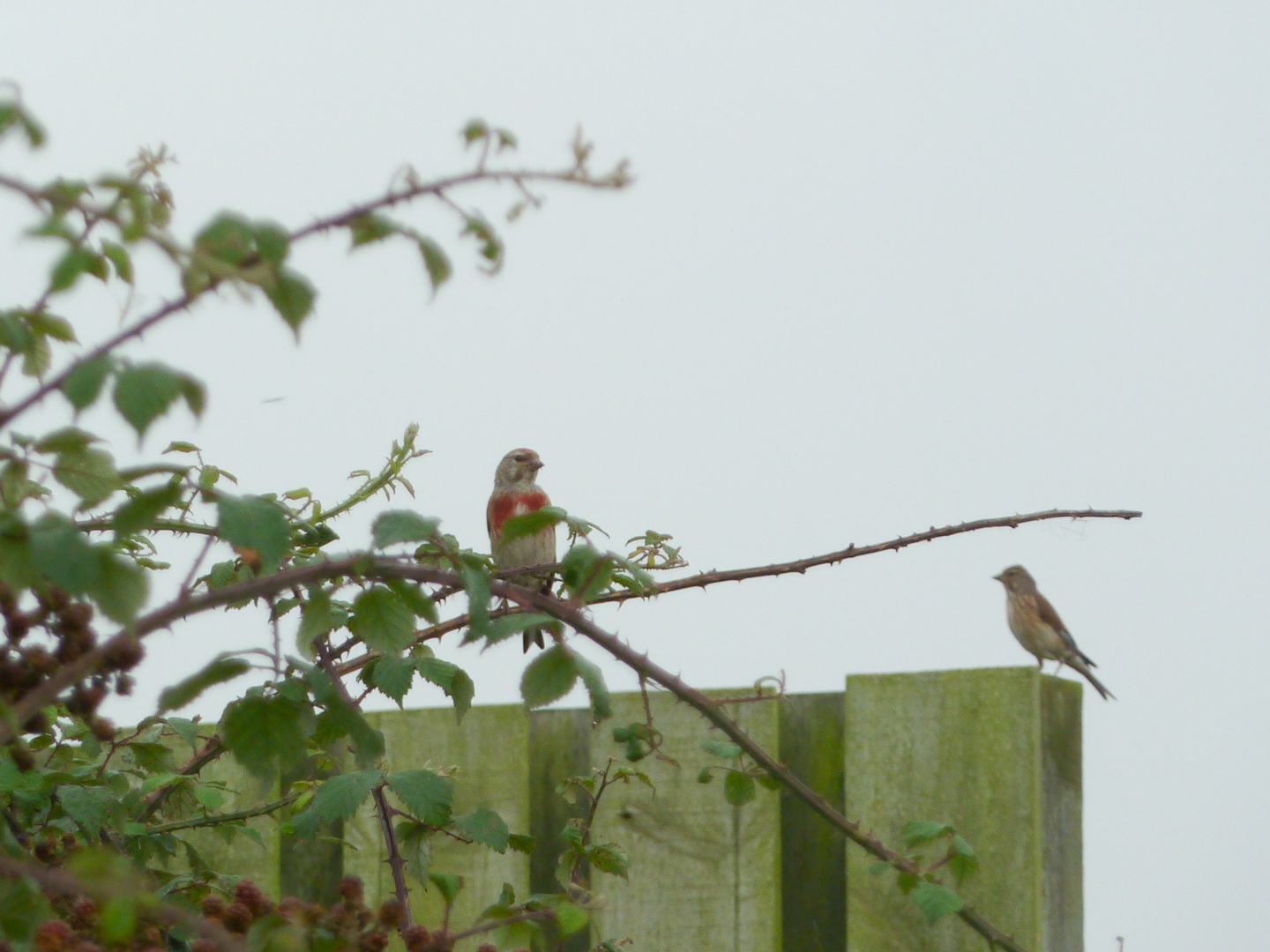
Firstly, getting over the dreaded lurgy - it took seven weeks to clear up and then after feeling better for about three days, I have another sore throat - so this may only be a short revival!

Secondly, very busy - lots of projects on, all coming to a head at the same time - nothing new there then!

Finally, socialising - finally managed to catch up with lots of my friends who I haven't had the opportunity to see for ages - you know who you are and I had a great time, thanks. Hugs to you all

The projects are very interesting.   Some friends are setting up an investigation at the Natural History Museum in London, to find herbarium sheets from Robert Pocock's original herbarium from the 1800's.   Very exciting, we get to trawl through hundreds of sheets from many botanists through the centuries looking for any specimens that were collected by Robert Pocock, who lived in North Kent in the 1800's and collected and exchanged botany samples with his contemporaries.   The aim is to re-create the herbarium, and bring this important botanist back into the public eye with talks and exhibitions in the area.   Funded by the Lottery Heritage Fund and aided by Kent Wildlife Trust, this is going to be a very interesting few months.

The second project is a little nearer to my heart, and will give me the opportunity to help REGUA, my 'local patch' in the Atlantic Rainforest in Brazil, with their communications and publicity - once again we have some support, this time from the World Land Trust-US.   The project already has strong links with the UK arm of the World Land Trust and this is an exciting extension of that connection.

Watch this space . . . . .

(next blog a bit more down to earth - Sheppey Update!)

Thursday, 29 August 2013

The Isle of Sheppey - but not as you know it!

Normally the Isle of Sheppey would give rise to thoughts of Elmley, Capel Fleet and Shellness, but today we decided to take a different tack, and go for some potential migrant habitat along the north coast.

We started out at Warden Point, a place I have only ever visited once before with rather soggy results - a cloudburst soaked us within minutes of our arrival.   On this occasion though, the sun was shining and the sky clear and blue - so off we set in eager anticipation.
Gatekeeper

From the car park we wandered towards some rough ground which looked prime insect habitat and with Swallow and House Martin swooping over our heads we watched Gatekeeper, Large White and Small Copper butterflies, and chased after grasshoppers galore, whilst listening for bush-crickets.

Linnet and House Sparrow were flitting around in the nearby brambles, as we carried on along the cliff top.  We were aiming for a small wood further along the coast.   Blue Tit and Great Tit were calling - I haven't seen either species for a couple of weeks, so it was good to see family groups with several downy juveniles being trained in the art of foraging.   Blackbird and Green Woodpecker called, whilst several Woodpigeon coo-ed from the tree tops.   Collared Dove, Chaffinch, Crow and Robin were all in this small area.   Sadly, as there were several well-walked paths through the trees, we were also having to be careful not to step in or on litter and rubbish which had been strewn around.
Not to be overlooked
Woodpigeon

Emerging onto the cliff top by a caravan park we were met with several butterfly species including Small Tortoiseshell, Clouded Yellow - including the first male I have seen this year, Large and Small White.  On the beach below we could see Little Egret, Herring Gull, Black-headed Gull and Magpie.   Near a small playing field we had Wren, Starling, a stunning Willow Warbler, Great Spotted Woodpecker, and Speckled Wood butterflies.

Time to move on and our next stop was Leysdown and lunch by the sea.   Here we added several more sea birds and waders including: Oystercatcher in their thousands, Curlew, Grey Plover and Bar-tailed Godwit.   Highlight of lunch wasn't the food today, but a huge downfall of insects which set Malcolm off on a mission to find as many different flies, beetles and various other species as he could.  They appeared to like the paler clothing of Irene and myself, but the car also provided a great backdrop - anyone passing would have been amused to see us all eyeing up the paintwork with eye-glasses at very close quarters!
Juvenile Jackdaw

Our final stop was Leas Cliff, where many families were enjoying the lovely weather, setting up camp on the beach and munching ice-creams.  We, of course, had far more important things on our mind, and wandered off towards the more wild end of the beach where the cliffs are gradually being eroded.   Swallows were flying west on migration, but there was precious little evidence of any other migration.   More Linnet, Starling, Woodpigeon, and Herring Gull were joined by a great little group of Ringed Plover and Turnstone on the shoreline.   To complete our bird list a Mediterranean Gull was seen at close quarters as we got back to the car.
Light brown apple moth (Epiphyas postvittana)

Monday, 26 August 2013

Oare in the rain

When you have a dose of man-flu the one thing you want to do is sit in a hide sheltering from the rain all day - not!

Still, I am a devoted member of my local RSPB (oops rspb) group and when Malcolm calls we all come running, so there were Irene and myself sitting in a car with torrential rain falling all around us waiting for someone - anyone - else to arrive.    When they did, the decision was made to move to a cafe until the rain stopped.
Golden Plover at Oare

So it was that at the ridiculous hour of 11.10 am we actually started the walk.

Swallow were flying low, taking advantage of a lull in the rain, the usual suspects of magpie and wood pigeon were soon added, house sparrow, cormorant, lapwing and starling were all easily spotted.   Snipe was a little more difficult, but thanks to Sally's usual good spotting we soon all saw the bird.

Plovers caused us some debate, first called as grey, they miraculously turned into golden after some debate and the fact that they had no back 'armpits' when they flew - one to the girls!

Chaffinch, coot and great black-backed gull were the next additions, and then we had the delight of thousands of black-tailed godwit - we tried for bar-tailed but couldn't find one.   Some of them were still in their breeding plumage, giving a glorious splash of colour to a grey day.
Waders in the rain

Grey heron appear to be back with us, I counted seven across the reserve today.   Little egret stood along the fringes of the east flood whilst others were feeding further out in the field ditches.   As we watched we noticed large numbers of redshank, several ruff, avocet, and a couple of pied wagtail.

A little tern headed towards us ditching into the water and washing itself as it splashed, occasionally mobbed half-heartedly by the godwit.   All the birds went up as a Sparrowhawk flew over our heads and off across the fields behind.   As we ended the morning session a large flock of ringed plover flew in to join the redshank.

After lunch - and another downpour - the slipway gave us some tern entertainment with sandwich and common, together with black-headed and common gull.   Herring gull held our attention for a nano-second until a lovely male marsh harrier flew into view off the Isle of Sheppey and towards us.
A spot of colour on a grey day - beautiful
male linnet and partner

From the hide o ear looking the river we saw great-crested grebe and shelduck, three common terns flew by very close which was great, but there was little else.   Along the muddy banks a family of yellow wagtail fed ahead of us as we braced ourselves against yet another downpour - so much for the BBC weather forecast!

The final stop back at the hide gave us lovely views of the godwit again, but we were also able to see dunlin, greenshank, a young water rail- thanks to Irene, and five curlew sandpipers - thanks to another bird watcher!
Hat now thoroughly weather tested! Passed with flying
colours- well chosen Rachel!

Needless to say after all this excitement I spent the next day in bed!

Friday, 23 August 2013

I think man flu has crossed over . . .


My reasoning is set out below, but bearing in mind I have now been ill for 16 days, sore throat, voice loss, hacking cough, aches, pains, migraine, sickness in fact is has gone on so long I can't remember getting a good nights sleep or actually feeling human.  
Also I DO hold to the strategy of "live for today" and I know my immune system is knackered - hence the shingles - simples - I do in fact have the female version of man flu!
part of Telegraph article Jan 2013:
" . . .  new research suggests that they are not faking it and that they suffer diseases more seriously and for longer.
Scientists believe it is the male predilection for a "live fast, die young" lifestyle that means in evolutionary terms they have failed to build up their immune systems like females.
That means that they not only catch more diseases but they tend to suffer more seriously, and for longer, from them.
A team at the University of Cambridge came up with the theory by applying a mathematical model to the various factors that characterise males and females"
Don't want to steal your thunder Lee - I'm sure you're still suffering more than me - well actually Rachel is probably suffering more from the moaning, but hope we're all better soon.

Thursday, 22 August 2013

Sun, Sea and . . . . .

a jolly good day out . . . .

This week my Wednesday team decided on a trip down to the cliffs near Dover and we headed for Bockhill, a great place for migrants set high up on the top of the white cliffs to the east of Dover.
Raven

Three Ravens called overhead as we arrived, then butterflies took over with Small Tortoiseshell, Wall (Brown), Large White, Common Blue, Small Copper and Clouded Yellow.  

A group of Whitethroat took our attention for some while as they fed in the safety of the scrub around us. Their contact calls gave their presence away, and we counted about four individuals.   After some time they flew off towards the edge of the cliff in their group.
Wall (Brown) Butterfly

Large numbers of Swallow were flying westwards - presumably feeding along the coast before they make the crossing.   Malcolm, Sally and Irene had views of a Common Redstart, and although I saw the bird on the deck it was some distance away and despite my efforts I could not get the bird in the bins to identify it myself.
Dusky Sallow

Our morning migrant sightings were completed with several Wheatear, a flock of Linnet and some great Whinchat - one of my favourites.

Two day-flying moths were identified as well, Silver Y and Dusky Sallow - thanks to Malcolm for the IDs.

As we took lunch by the beach, a Fulmar flew along the cliff face using the thermals created by the midday sun.

In the afternoon, we moved on to Samphire Hoe - I hadn't been there this year yet.   A Common Buzzard greeted us - soaring along the cliff top disturbing smaller birds below.
Butterfly heaven

We added Marbled White, Gatekeeper, Peacock, Small White and Speckled Bush Cricket to our insect list.

Along the concrete promenade we found a couple of Rock Pipits - feeding along the rough grass above and dropping down to pick morsels from the cracks and crevices.   More Swallow were moving westwards and then I heard the distinctive "chirp" of House Martin.   Looking around I couldn't see where they were, then high up in sky over the sea I spotted a couple of Martins, and the more I looked the more I saw.   Several appeared to disappear onto the cliff face, but whether they landed we could not tell.   Sad to see them on their way back to Africa, but I love migration full stop.

Wednesday, 21 August 2013

Rainham Marshes

I spent yesterday at Rainham Marshes with my local rspb group.   The real highlight of the day wasn't an avian one, but human . . . .  I'll come to that later, however.
Wasp Nest

Having read that a survey has been done of Harbour and Grey Seals in the lower Thames Estuary, it was good to see several Harbour Seals hauled up on the Dartford side of the River.

On the reserve itself there were several Little Grebe with juveniles, young Moorhen and Coot, a fledgling Reed Bunting, flocks of House Sparrow with young birds begging from their parents, young Bearded Tit feeding on seeds in the reedbeds  - all signs of successful fledging.   A group of over 30 Goldfinch with many young birds included, were flying between the larger shrubs along the side of the path.
Grey Heron with wings outstretched

A Grey Heron was standing with its wings outstretched, presumably enjoying the warm summer sun, but it made a strange sight - never seen one stand quite in this way before!

I spotted three Hobby flying over one of the scrapes on the far side of the reserve, and as they moved nearer to us we could see them catching dragonflies and eating on the wing.   It was a great day for Hawkers with Migrant and Brown Hawker seen in large numbers, and Common Darter were also quite numerous.

Butterflies noted were Large White, Small Tortoiseshell, Gatekeeper, Common Blue, Clouded Yellow.
Small Tortoiseshell

Other species which added to the day were Water Vole and Marsh Frog, Reed Warbler, Sedge Warbler, Black-tailed Godwit, Shoveler, Pochard, Mallard and Teal.

So, to my human highlight of the day!
We met up with two young lads - probably mid-teens.   One had been interested in birds for a couple of years, the other was on his first day out.   They had made the trip on public transport from Brixton to Rainham - for the more experienced lad it was his second trip in a few days - he had seen the Wood Sandpiper on his last trip and promised to show it to us!   They then joined us for the majority of our walk, and their pleasure and enthusiasm was great to see.  The Hobby were firsts for them, and they thought watching the dragonflies dicing with death nearby were "awesome".   We also saw a rather badly moulted Kestrel and a Sparrowhawk, and both were met with equal joy.   Their interest in all we saw was a delight, and as we walked along, it was great to chat to such eloquent and enthusiastic youngsters - it made me realise that there is hope for the future with some people.   After discussing options for their future birding ventures, they departed - they had of course shown us where the Wood Sandpiper was, with a Ruff nearby.
Pied Shield-bug

The old Pollyanna "it makes my heart glad" was ringing in my ears for the rest of the day.