Blog Archive

Thursday, 29 August 2013

The Isle of Sheppey - but not as you know it!

Normally the Isle of Sheppey would give rise to thoughts of Elmley, Capel Fleet and Shellness, but today we decided to take a different tack, and go for some potential migrant habitat along the north coast.

We started out at Warden Point, a place I have only ever visited once before with rather soggy results - a cloudburst soaked us within minutes of our arrival.   On this occasion though, the sun was shining and the sky clear and blue - so off we set in eager anticipation.
Gatekeeper

From the car park we wandered towards some rough ground which looked prime insect habitat and with Swallow and House Martin swooping over our heads we watched Gatekeeper, Large White and Small Copper butterflies, and chased after grasshoppers galore, whilst listening for bush-crickets.

Linnet and House Sparrow were flitting around in the nearby brambles, as we carried on along the cliff top.  We were aiming for a small wood further along the coast.   Blue Tit and Great Tit were calling - I haven't seen either species for a couple of weeks, so it was good to see family groups with several downy juveniles being trained in the art of foraging.   Blackbird and Green Woodpecker called, whilst several Woodpigeon coo-ed from the tree tops.   Collared Dove, Chaffinch, Crow and Robin were all in this small area.   Sadly, as there were several well-walked paths through the trees, we were also having to be careful not to step in or on litter and rubbish which had been strewn around.
Not to be overlooked
Woodpigeon

Emerging onto the cliff top by a caravan park we were met with several butterfly species including Small Tortoiseshell, Clouded Yellow - including the first male I have seen this year, Large and Small White.  On the beach below we could see Little Egret, Herring Gull, Black-headed Gull and Magpie.   Near a small playing field we had Wren, Starling, a stunning Willow Warbler, Great Spotted Woodpecker, and Speckled Wood butterflies.

Time to move on and our next stop was Leysdown and lunch by the sea.   Here we added several more sea birds and waders including: Oystercatcher in their thousands, Curlew, Grey Plover and Bar-tailed Godwit.   Highlight of lunch wasn't the food today, but a huge downfall of insects which set Malcolm off on a mission to find as many different flies, beetles and various other species as he could.  They appeared to like the paler clothing of Irene and myself, but the car also provided a great backdrop - anyone passing would have been amused to see us all eyeing up the paintwork with eye-glasses at very close quarters!
Juvenile Jackdaw

Our final stop was Leas Cliff, where many families were enjoying the lovely weather, setting up camp on the beach and munching ice-creams.  We, of course, had far more important things on our mind, and wandered off towards the more wild end of the beach where the cliffs are gradually being eroded.   Swallows were flying west on migration, but there was precious little evidence of any other migration.   More Linnet, Starling, Woodpigeon, and Herring Gull were joined by a great little group of Ringed Plover and Turnstone on the shoreline.   To complete our bird list a Mediterranean Gull was seen at close quarters as we got back to the car.
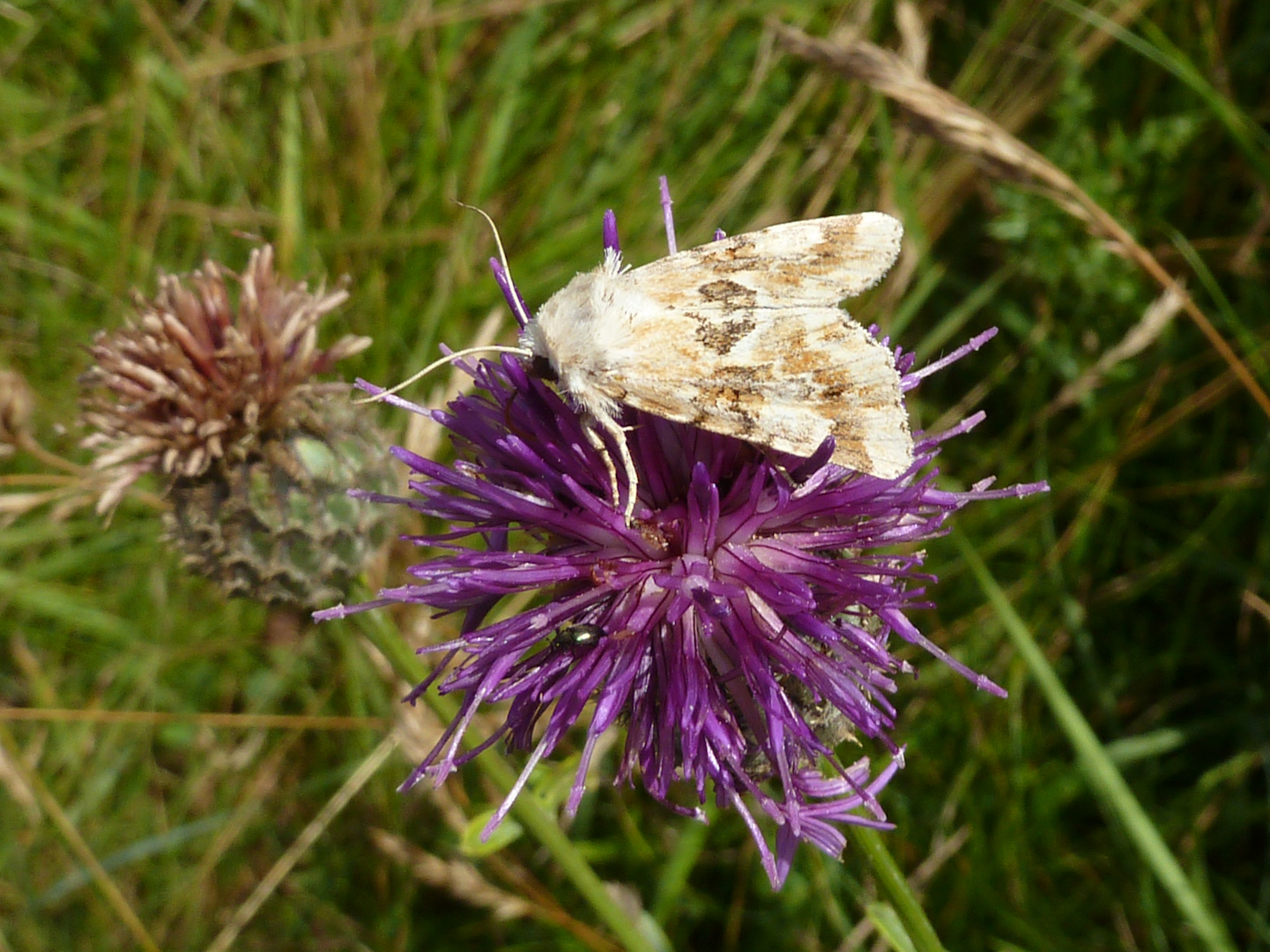
Light brown apple moth (Epiphyas postvittana)

Monday, 26 August 2013

Oare in the rain

When you have a dose of man-flu the one thing you want to do is sit in a hide sheltering from the rain all day - not!

Still, I am a devoted member of my local RSPB (oops rspb) group and when Malcolm calls we all come running, so there were Irene and myself sitting in a car with torrential rain falling all around us waiting for someone - anyone - else to arrive.    When they did, the decision was made to move to a cafe until the rain stopped.
Golden Plover at Oare

So it was that at the ridiculous hour of 11.10 am we actually started the walk.

Swallow were flying low, taking advantage of a lull in the rain, the usual suspects of magpie and wood pigeon were soon added, house sparrow, cormorant, lapwing and starling were all easily spotted.   Snipe was a little more difficult, but thanks to Sally's usual good spotting we soon all saw the bird.

Plovers caused us some debate, first called as grey, they miraculously turned into golden after some debate and the fact that they had no back 'armpits' when they flew - one to the girls!

Chaffinch, coot and great black-backed gull were the next additions, and then we had the delight of thousands of black-tailed godwit - we tried for bar-tailed but couldn't find one.   Some of them were still in their breeding plumage, giving a glorious splash of colour to a grey day.
Waders in the rain

Grey heron appear to be back with us, I counted seven across the reserve today.   Little egret stood along the fringes of the east flood whilst others were feeding further out in the field ditches.   As we watched we noticed large numbers of redshank, several ruff, avocet, and a couple of pied wagtail.

A little tern headed towards us ditching into the water and washing itself as it splashed, occasionally mobbed half-heartedly by the godwit.   All the birds went up as a Sparrowhawk flew over our heads and off across the fields behind.   As we ended the morning session a large flock of ringed plover flew in to join the redshank.

After lunch - and another downpour - the slipway gave us some tern entertainment with sandwich and common, together with black-headed and common gull.   Herring gull held our attention for a nano-second until a lovely male marsh harrier flew into view off the Isle of Sheppey and towards us.
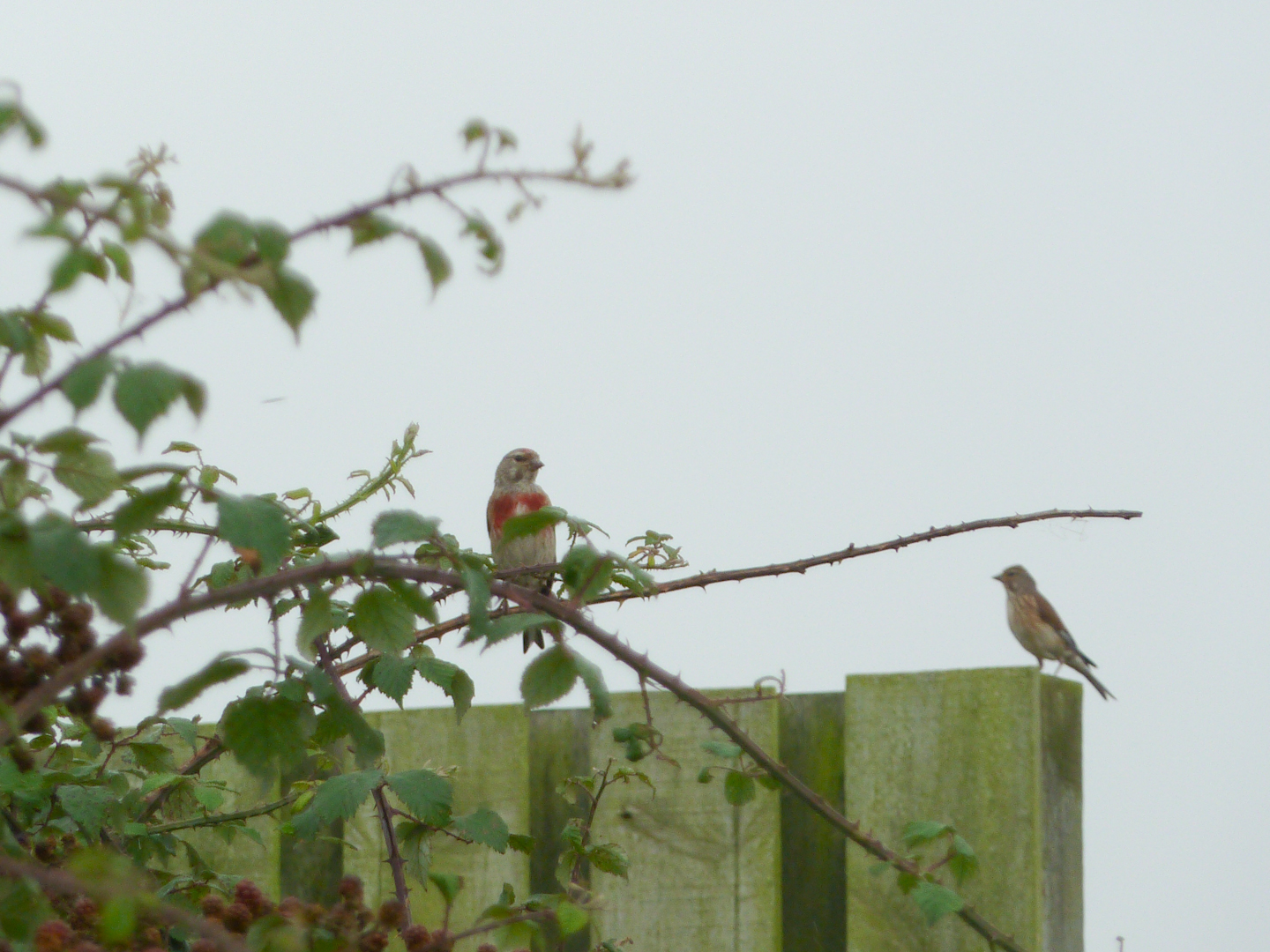
A spot of colour on a grey day - beautiful
male linnet and partner

From the hide o ear looking the river we saw great-crested grebe and shelduck, three common terns flew by very close which was great, but there was little else.   Along the muddy banks a family of yellow wagtail fed ahead of us as we braced ourselves against yet another downpour - so much for the BBC weather forecast!

The final stop back at the hide gave us lovely views of the godwit again, but we were also able to see dunlin, greenshank, a young water rail- thanks to Irene, and five curlew sandpipers - thanks to another bird watcher!
Hat now thoroughly weather tested! Passed with flying
colours- well chosen Rachel!

Needless to say after all this excitement I spent the next day in bed!

Friday, 23 August 2013

I think man flu has crossed over . . .


My reasoning is set out below, but bearing in mind I have now been ill for 16 days, sore throat, voice loss, hacking cough, aches, pains, migraine, sickness in fact is has gone on so long I can't remember getting a good nights sleep or actually feeling human.  
Also I DO hold to the strategy of "live for today" and I know my immune system is knackered - hence the shingles - simples - I do in fact have the female version of man flu!
part of Telegraph article Jan 2013:
" . . .  new research suggests that they are not faking it and that they suffer diseases more seriously and for longer.
Scientists believe it is the male predilection for a "live fast, die young" lifestyle that means in evolutionary terms they have failed to build up their immune systems like females.
That means that they not only catch more diseases but they tend to suffer more seriously, and for longer, from them.
A team at the University of Cambridge came up with the theory by applying a mathematical model to the various factors that characterise males and females"
Don't want to steal your thunder Lee - I'm sure you're still suffering more than me - well actually Rachel is probably suffering more from the moaning, but hope we're all better soon.

Thursday, 22 August 2013

Sun, Sea and . . . . .

a jolly good day out . . . .

This week my Wednesday team decided on a trip down to the cliffs near Dover and we headed for Bockhill, a great place for migrants set high up on the top of the white cliffs to the east of Dover.
Raven

Three Ravens called overhead as we arrived, then butterflies took over with Small Tortoiseshell, Wall (Brown), Large White, Common Blue, Small Copper and Clouded Yellow.  

A group of Whitethroat took our attention for some while as they fed in the safety of the scrub around us. Their contact calls gave their presence away, and we counted about four individuals.   After some time they flew off towards the edge of the cliff in their group.
Wall (Brown) Butterfly

Large numbers of Swallow were flying westwards - presumably feeding along the coast before they make the crossing.   Malcolm, Sally and Irene had views of a Common Redstart, and although I saw the bird on the deck it was some distance away and despite my efforts I could not get the bird in the bins to identify it myself.
Dusky Sallow

Our morning migrant sightings were completed with several Wheatear, a flock of Linnet and some great Whinchat - one of my favourites.

Two day-flying moths were identified as well, Silver Y and Dusky Sallow - thanks to Malcolm for the IDs.

As we took lunch by the beach, a Fulmar flew along the cliff face using the thermals created by the midday sun.

In the afternoon, we moved on to Samphire Hoe - I hadn't been there this year yet.   A Common Buzzard greeted us - soaring along the cliff top disturbing smaller birds below.
Butterfly heaven

We added Marbled White, Gatekeeper, Peacock, Small White and Speckled Bush Cricket to our insect list.

Along the concrete promenade we found a couple of Rock Pipits - feeding along the rough grass above and dropping down to pick morsels from the cracks and crevices.   More Swallow were moving westwards and then I heard the distinctive "chirp" of House Martin.   Looking around I couldn't see where they were, then high up in sky over the sea I spotted a couple of Martins, and the more I looked the more I saw.   Several appeared to disappear onto the cliff face, but whether they landed we could not tell.   Sad to see them on their way back to Africa, but I love migration full stop.

Wednesday, 21 August 2013

Rainham Marshes

I spent yesterday at Rainham Marshes with my local rspb group.   The real highlight of the day wasn't an avian one, but human . . . .  I'll come to that later, however.
Wasp Nest

Having read that a survey has been done of Harbour and Grey Seals in the lower Thames Estuary, it was good to see several Harbour Seals hauled up on the Dartford side of the River.

On the reserve itself there were several Little Grebe with juveniles, young Moorhen and Coot, a fledgling Reed Bunting, flocks of House Sparrow with young birds begging from their parents, young Bearded Tit feeding on seeds in the reedbeds  - all signs of successful fledging.   A group of over 30 Goldfinch with many young birds included, were flying between the larger shrubs along the side of the path.
Grey Heron with wings outstretched

A Grey Heron was standing with its wings outstretched, presumably enjoying the warm summer sun, but it made a strange sight - never seen one stand quite in this way before!

I spotted three Hobby flying over one of the scrapes on the far side of the reserve, and as they moved nearer to us we could see them catching dragonflies and eating on the wing.   It was a great day for Hawkers with Migrant and Brown Hawker seen in large numbers, and Common Darter were also quite numerous.

Butterflies noted were Large White, Small Tortoiseshell, Gatekeeper, Common Blue, Clouded Yellow.
Small Tortoiseshell

Other species which added to the day were Water Vole and Marsh Frog, Reed Warbler, Sedge Warbler, Black-tailed Godwit, Shoveler, Pochard, Mallard and Teal.

So, to my human highlight of the day!
We met up with two young lads - probably mid-teens.   One had been interested in birds for a couple of years, the other was on his first day out.   They had made the trip on public transport from Brixton to Rainham - for the more experienced lad it was his second trip in a few days - he had seen the Wood Sandpiper on his last trip and promised to show it to us!   They then joined us for the majority of our walk, and their pleasure and enthusiasm was great to see.  The Hobby were firsts for them, and they thought watching the dragonflies dicing with death nearby were "awesome".   We also saw a rather badly moulted Kestrel and a Sparrowhawk, and both were met with equal joy.   Their interest in all we saw was a delight, and as we walked along, it was great to chat to such eloquent and enthusiastic youngsters - it made me realise that there is hope for the future with some people.   After discussing options for their future birding ventures, they departed - they had of course shown us where the Wood Sandpiper was, with a Ruff nearby.
Pied Shield-bug

The old Pollyanna "it makes my heart glad" was ringing in my ears for the rest of the day.

Tuesday, 20 August 2013

Bird Fair Blues ~ roll on next year

Its absolutely true, even though I was struggling with a bad throat and loss of voice, I still had a great time at the Bird Fair, and I miss it now its over.

A novice at this game, I have only been to the Fair around eight times, and only two of them as an exhibitor for REGUA, the Reserve in Brazil that I volunteer for.   Still, I love the atmosphere of the place, all those people gathering from around the world once a year for the same reason.  Their love of birds and all things natural and environmental.

Most of the exhibitors are there to make money one way or another, by selling holidays, books or equipment, or by a subscription to a worthy cause, others are there to sell a concept - as in REGUA's case - but without a basic interest in the natural world we wouldn't be there.
Privet Hawkmoth Caterpillar

Wandering around, bumping into old friends, making new friends, the whole event is a sociable cornucopia, and one which I would now greatly miss if I was not part of it.  

The highlights for me were:

Chatting to Bill Oddie (who has visited REGUA in the past) about the progress we have made and continue to make, and how the reforestation of the Guapi-Assu valley has provided corridors for wildlife to use and expand into.   This gives us both hope for the future - proving that the tide of destruction can be turned.
Success!

Watching the sheer joy on a child's face as she held a Privet Hawkmoth caterpillar, she giggled as it tickled her hand and was in absolute awe at its beauty.

The successes of two groups of friends with stands;
Firstly, Skua Nature an Italian group who aim to provide not only holidays but research, teaching and habitat restoration and protection to a wide group of people from Italy and around the world - they were a roaring success winning Best Overseas Stand and Best Overall Stand
Secondly, Wise Birding who managed to give away virtually all their brochures for next year, and also adding to their portfolio of bookings.

My personal success was planning my 2014 Holiday Plans - yippee!   At the Bird Fair it took about 15 minutes - at home I would have pondered for days . . . . .

And if Lee, Rachel, Alan and I wondered if we had made any impact at all for our beloved Reserve, we were left in no doubt when a couple wandered up to tell us what a great time they had on holiday this year.   They booked after meeting us at the Bird Fair last year - you see we can turn your dreams into reality!
All over until next year

. . . . . and I have just had an email today from a couple asking to book for 2015.

Wednesday, 24 July 2013

The View is Back!

After a day out birding offsite, we returned to the Lodge and were met by a Ferruginous Pygmy Owl "in my garden" so to speak (sorry Lee!).
Sunset over Regua Mountains

Whilst we were out the gardeners had lopped and chopped some trees on the edge of the garden to open up the view of the nearby hillsides where the reforestation progress has been almost too successful.

With the view opened up, and more light in the garden, we can now see Channel-billed Toucan and Bare-necked Bellbirds from the lodge garden again - at least until the trees grow up again!

Tuesday, 23 July 2013

Shrike-like Cotinga

I have been coming out to REGUA each year since 2006.   It took me five years to see this enigmatic species and one for which the Reserve has rightly become famous.   It is one of the best places to see the bird - but not when you are either at the back of the group when the bird is seen at the front or vice versa - as was the case for me in 2009!

In 2010 I had one good view, but last year I even managed to find my own on one of the trails behind the wetland, and notched up five excellent viewings.  

This year, we saw an individual within five minutes of getting out of the vehicle on our first forest walk!   You can't ask for better.
Shrike-like Cotinga

As always, I favoured watching the bird rather than reaching for the camera straight away, but I wish I had actually changed my tack this time, as others had far better photographs.

Incidentially, despite several groups going off in search over the next couple of weeks, no-one else has see or indeed heard it - so perhaps it has already started its annual migration to higher altitudes.

Sumidoro

Leonardo, one of the REGUA Guides treated us to a great days birding at Sumidoro.   The list of birds seen, and the views we had were great.

A pair of displaying Blue-winged Macaw gave us a spectacular opportunity to watch their inter-action.   At times they flew in complete synchronicity, swooping and soaring - calling as they displayed.   Then, at rest in a near tree, they continued to pair-bond with pecking, grooming and contact 'chipping' to each other.   We spent ages just enjoying them and snapping away with the cameras - over a thousand shots must have been taken by the group in all - some taking more than others!
Blue-winged Macaw

We had several stops along the road, and were surprised at the number of birds to be found in the scrappiest bits of habitat.   One flock had over a dozen species and gave us all the chance to take our time over birds which had previously been very shy.   

There were also some delightful new species for our trip list including; Magpie Tanager, Gilt-edged Tanager, Ruby-crowned Tanager, Dusky-legged Guan, Glittering-bellied Emerald, Toco Toucan, Serra Antwren and Southern Beardless Tyrannulet.
Gilt-edged Tanager

The Three-toed Jacamar gave their usual brilliant showing with at least eight individuals being found. A very obliging Surucua Trogon sat right in front of us for ages, allowing great photo opportunities.   Grey-eyed Greenlet is another lovely species to find here, and once more Leonardo managed to get great views for us all.

A Ferruginous Pygmy Owl started to call and was mobbed by Violet-capped Woodnymphs and Tanagers.   This forced the Owl to fly further away from us, but still within lens distance for some.

Several American Kestrels were seen perched on wires and telegraph poles.   On the way back Leonardo had another couple of stops up his sleeve and one of our party's wish list was found at the first - Firewood Gatherer - what a great name.   Their nests were to be found in a nearby tree - typically made of twigs laid between the branches of the tree and the trunk.   Rufous Hornero nests (from the Ovenbird family) were also in the same tree - no need to describe what they look like I am sure!
Hornero nest

Streamer-tailed Tyrant responded immediately, giving a great display for everyone, even though the drizzle was starting to fall by this time. 
White-eared Puffbird

A couple of White-eared Puffbird (one of my favourite families) posed well in a tree for us as Curl-crested Jays flew around chattering to each other as they moved from tree to telegraph wire and back to tree.

In addition to all this we also saw Rufous-fronted Thornbird, Sepia-capped Flycatcher, Hangnest Tody-tyrant, Cliff Flycatcher, Long-tailed Tyrant, Brown-crested Flycatcher, Rufous-browed Peppershrike, Crested Oropendola, Rufous-headed Tanager, Uniform Finch, Pileated Finch, and Double-collared Seedeater.

What a great day!

Monday, 22 July 2013

Around and About

During my first ten days here, I had the luxury of a holiday, and spent time on day excursions to Rio - where for once the sun shone and we had great views from the top of the Sugar-Loaf Mountain, of both the City and many beaches stretching out below us and the Christ the Redeemer statue on top of the Corcovada.
Christ the Redeemer watching over Rio

The Botanic Gardens were great too with close views of Channel-billed Toucan, hybrid Common Marmosets, Rusty-margined Guan and Slaty-breasted Wood-Rail.

Added to this the trees and plants are fantastic and with Nicholas and Raquel as our guides we couldn't wish for better.

An al fresco lunch in the cobbled alleys of the old town with musicians playing typical Brazilian samba music made for a relaxing day in this hectic city.   A short walk nearby brought us to the original building where slaves were brought to Brazil on ships from Africa.   Having been to Ghana and seen the start of their journey, it somehow closed the circle for me.   Amazing to see the steps leading up from the original quay-side and the gate through which their future life began.   A very sobering sight indeed.
View from Sugar Loaf

After lunch Alcenir drove us along the 'Copacabana Crawl' so called as the traffic along this part of the city is so slow.   We were lucky and managed to get along without too much difficulty.   We did a complete circuit of the Bay and then made our way back to peace and serenity at the Reserve.

Tuesday, 16 July 2013

Bird watching in Paradise

Whatever anyone tells you, believe me, birding in Kent has nothing on Brazil!   I've just spent ten days on holiday at Regua, in the Brazilian Atlantic Rainforest.   Followers will know that it is my second home, and will therefore skip, the next few blogs!   However, despite my regular trips the place just continues to deliver new delights every time.
Early morning from the Garden

The rainforest restoration is expanding rapidly and with that increased species diversity.   With 170,000 trees planted in the last twelve years, and a further 180,000 to go in over the next two years, there are going to be more changes still!

Around the lodge, the view of some of the surrounding mountains has been rescued from the rapidly expanding forest.   A moth wall has been erected and a grand new two-storey Belvedere has been built enabling great views of the wetland and the sunset over the mountains from the edge of the garden.   So good is this new viewpoint, we spent two hours there on our first morning enjoying tanager flocks and blue dacnis at eye level, and scanning the forest canopy for raptors and sloth.  No-one was in a hurry to leave and start the walk!

Familiar sights greet us also, the team at the lodge are as friendly as ever, nothing is too much trouble for them, and great food in the relaxed atmosphere is always a highlight here.   With the arguments between swallow-tailed hummingbirds still continuing over the feeders in the garden which they defend vociferously against the glittering-throated emerald and violet-capped woodnymph its just like coming home.
Chestnut-backed Antshrike

Blonde-crested woodpecker and white-tufted marmoset feeding in the bananas in the garden delayed breakfast and our departure on several days.   Whilst the call of channel-billed toucan and bare-necked bellbird accompanied our days as we relaxed around the pool and on the veranda.

Sunday, 14 July 2013

Regua phase one

So, here I am on my annual sojourn to Regua the Brazilian Atlantic Rainforest Reserve north of Rio.   On my 8th visit now, so you would think that the magic would have faded!   No such luck, its still a fantastic place to go birdwatching and walking, and it makes my heart swell with delight as I get nearer to those distinctive mountains.

Updates to follow but this was to whet your appetite, or enable to get to sleep, depending on your ability to enjoy someone else's travels . . . . . I can hear the snores from here.   Zzzzzzzzzzzz

Thursday, 27 June 2013

Cliffe in the Sunshine

This week our usual weekly walk took us to Cliffe.      We were met with a cacophany of sound from the Black-headed Gulls on the first pool, where there were also Tufted Duck, Great Crested Grebe, Coot and Canada Geese.   From the bushes and trees around the car park and along the first part of our walk were there several Blackcap, Dunnock - with a least one family group found, Wren, Woodpigeon, Magpie and Whitethroat.   Stock Dove was pointed out by Irene as it called from the Pinnacle area.   As Sally and I tried to video a stunning male Blackcap as it sang from the top of a bush, Irene and Malcolm were watching a Mediterranean Gull which had announced its arrival overhead.   Meadow Brown, Holly Blue, Red Admiral and Common Blue Butterflies were seen as we continued our walk.   Goats Rue and Dog Rose were in full flower, with Creeping Cinquefoil, Eyebright and Hounds Tongue also identified.   Malcolm showed Irene and I how to identify Perforate St Johns Wort - with small perforations in the leaves which show will when you use an eyeglass!
Singing Male Blackcap

We continued along the path between the pools and heard Chiffchaff and Goldfinch.   A Blackbird alarmed as we continued along and a Nightingale shot across the path in front of us.   A Wren called from the depths of a bramble and mimicked part of Yellowhammer call within its repertoire.    Overhead Common Tern, Swallow and Skylark were seen and heard and a group of four Avocet were mobbing corvids ferociously, as presumably they had young nearby which were under threat.   Shelduck loafed around at the end of Flamingo pool, with a large number of Avocet, including several youngsters, and Oystercatchers.   A Meadow Pipit displayed as we neared the seawall, and a couple of Linnet flew ahead of us.
Holly Blue Butterfly

We had our lunch stop in the shelter of the seawall watching the tide come in, and piecing together the landmarks on the Essex side of the Thames.   After a well-earned rest we were off again to continue our circuit.    Along the way we managed to add a few more species to our list for the day including Crow, Kestrel, Stock Dove seen rather than heard, Starling, Greenfinch, a stunningly handsome male Stonechat, Marsh Harrier, Hobby and Pheasant.   Little Grebe squealed from one of the ditches running alongside the path.   Marsh Frogs croaked and Emperor Dragonfly and Blue-tailed Damselfly were also identified.

From the Black Barn area we added to our wader list with Greenshank, Redshank, Black-tailed Godwit and lapwing.   Ducks on one of the deeper pools included Teal, Gadwall, and more Tufted Duck.     A female Reed Bunting called our attention as we were enjoying a family of Greenfinch which were feeding along the side of the path ahead of us.
Avocet Mobbing Corvids

The final part of the path gave us a brilliant show of Swift and Swallow - both in large numbers, and the occasional House Martin.   Curlew and Whimbrel, Little Egret, and the explosive call of the Cetti's Warbler helped us on our way back to the car.   The final addition was the sight of a family of Blue Tit.

Tuesday, 25 June 2013

Sevenoaks Wildlife Reserve

Twenty-one of us joined Malcolm and Sally for this Tuesday walk at the ever-popular wildlife reserve at Sevenoaks.   From the car park we could hear Chiffchaff and Robin singing away enjoying the morning sunlight.   Willow Warbler and Garden Warbler were heard by the leading group, with Wren, Magpie and Jay added in quick succession by us all.    Willow seeds were blowing around on the breeze - an excellent display of seed distribution!
Common Spotted Orchid

A scan of the water from the small viewpoint added several water birds to our list, including Canada Geese, Greylag Geese, Tufted Duck, Coot - with two still on nests - and Mute Swan.   A Song Thrush delighted us with its song, phrases being repeated two and three times making it easy to point out to everyone.   We are now experts!     Chaffinch called from perches in the trees and bushes as we continued our walk.   A black and yellow Longhorn Beetle intrigued us and Common Spotted Orchid and Figwort delighted us.   A family of Blue Tits with several young, "seeped" from their hiding places, keeping contact and reassuring each other as we passed by.   Malcolm pointed out sawfly galls on the willows, where bright red lumps appear as the gall develops.
Figwort

Our education was also expanded by finding Banded Demoiselle, Small Red-eyed Damselfly and Small Tortoiseshell Caterpillars.     A Grey Squirrel ran along branches above us sending birds off in fright.   Near one of the hides we found both Blackcap and Dunnock families.    The Blackcaps were rather secretive, with the youngsters huddled low down on a branch almost covered by grass, whilst the female looked on and the male ferried food back and forth to his young family.   The Dunnock on the other hand were sitting in a bare bush preening, with their parents keeping a watchful eye.

Red Admiral, Small White and Speckled Wood Butterflies were added by some and as we continued there were the distinctive "cigar-shaped" rolls of nettle leaves, which are the hiding place for Mother of Pearl Moth caterpillars.   Nettle Tap Moths were also quite numerous around the reserve - once we  saw one, we realised there were many of them around.
Nettle Tap Moth

From the main hide overlooking the largest lake we watched Pied Wagtail with their chick, Little Ringed Plover, Lapwing, Mallard, Grey Heron, Cormorant, Egyptian Geese and Great Crested Grebe.   We also found a dead mole - but the less said about that the better . . . .


Wednesday, 19 June 2013

Rye Harbour Phase 2

Twice in four days?   Well Rye Harbour is a very special place for wildlife of all sorts.

The sightings in the car park were Herring gull, Starling and Goldfinch.   As we walked along the footpath we noted Salsify, Slender Thistle, Sea Kale and Yellow Horned Poppy in flower.   A couple of hairy moth caterpillars caught Malcolm's attention, Brown Tailed and Oak Eggar - further along we found another, the Pale Grass Eggar.   Our non-avian list rumbled along as we added Small Copper, Common Blue and Painted Lady butterflies.
Pale Grass Eggar

In the avian world however, it was a hectic whirl of parenting and defending nests which just makes our species look like amateurs.   Little Tern nests were being threatened by Rooks, Common Terns joined in the mobbing in an attempt to protect the youngsters.   Black-headed Gulls squawked away making a cacophonous din, constantly calling to each other, their chicks and their neighbours.   Often a chick or adult would get the geography a little wrong and what appeared to be vicious pecking and kicking would be called for until the interloper found its rightful nest and order was restored.
Painted Lady on Valerian

A group of Cormorants enjoyed peace on their own island drying their wings in the sunshine.   One adult was trying to encourage its fledgling to feed, and repeatedly dived then surfaced until the youngster got the message.   Three Little Egret hunted for small fish along the edges of the pools, keeping out of the main areas of contention.

Away from the water we heard a Cuckoo calling and found Wheatear families (potentially two) with adult males feeding fledglings which constantly begged for food.   We also found a male Linnet dutifully feeding its young.  Both species were encouraging their young to fend for themselves - but with what appeared to be little success.

A Ringed Plover was hunkered down in the shingle viewable from the new hide near Lime Kiln Cottage, it didn't move all the time we watched, so could be on a nest.   Several Avocet were adopting a similar pose.
Blurry, but a Skylark singing on high!

Several Mediterranean Gulls were on nests and we saw one chick which was preening by an adult.   The Common Terns were raising young too with at least four families viewable with young fluffy spotty chicks.  One family appeared to be reliant on one parent and hid behind a stone until food arrived.  Not the best of circumstances as when one of the chicks ventured out from its cover it got a vicious peck and head bashing from another adult Tern.    A second nest had a parent standing guard whilst its mate collected food, in the third chick was happily snuggled under mum or day and poked its head out from under the adult's wing every now and then to see how the neighbours were doing.   Other birds appeared to be sitting on nests and one couple looked as if they were still scraping out a nest, so there could be more young on the way.
Common Tern

A Great-crested Grebe and Little Grebe were also noted amongst the other occupants of the Ternery Pool which included Tufted Duck, Mallard, Greylag Geese with young, and a large contingent of Sandwich Terns.

On our return journey Sally spotted a couple of Stock Dove feeding in the shingle ridges and a Hobby shot through with some Swallows.

Sunday, 16 June 2013

Happy Birthday Phil

I had a great day in Rye with Phil on Sunday.   The weather was kind most of the day.   After cups of tea and birthday gifts we went off to Pett Levels for a walk.   This is where the "most of the day" came in as the heavens opened and heavy rain fell.

We decided to go to the shelter of one of the hides in the nearby reserve.   The list of birds came thick and fast, giving me a great opportunity to use the new BirdTrack app!   Amongst those birds seen were Canada Geese, Greylag, Gadwall, Grey Heron, Cormorant, Coot, Common Tern, Coot, Moorhen, Lapwing, Ringed Plover, Mallard, Mediterranean Gull, Black-headed Gull, Mute Swan, Oystercatcher, Redshank, Shoveler and Tufted Duck.   A large number of Swift fed over the water, and several Swallow were also spotted.

On nearby fields Woodpigeons fed amongst the deer.   Around the hide we heard Sedge and Reed Warbler in the reedbeds alongside the ditches and scrape and saw a Reed Bunting.   On the way back for lunch we found Stock Dove and Pheasant in the fields.

Back home and the benefits of living in the middle of a field are always a delight for me - the place is absolutely surrounded by birds!   From the kitchen window we watched the feeders where Bullfinch, Chaffinch, Great Spotted Woodpecker, Collared Dove, Blue Tit, Greenfinch, Blackbird, Song Thrush,  Dunnock, Goldfinch, Magpie and Nuthatch took advantage of the goodies available.  

A pair of Marsh Harrier hunted over the reedbeds, and we were lucky enough to see a food exchange.   A female Sparrowhawk shot past right in front of us, but immediately disappeared.

The weather improved so we took off to Rye Harbour for a wander.   Many birds were repeats of this morning's sightings, but we also added some great species.   Walking down the path we had Rock Pipit displaying, with Skylark also singing from high up.   Three Wheatear were spotted from the hide along with Little Tern calling overhead.   As we continued following the river Lesser and Great Black-backed Gull, Herring Gull, a hovering Kestrel and a couple of Linnet were added.  

From the scrape we had huge numbers of Black-headed Gulls with a few Mediterranean thrown in for good measure.   One of the islands had about 20 Sandwich Terns, it was hard to tell if they were on nests, but a few of them did appear to be quite hunkered down - so lets hope so.   Cormorants were grouped on the far side of the water, and a lone Little Egret rested on the edge.  

Walking back through the caravan park I noticed what I thought were two Stock Doves on the ground, just as I started to say it though, I realised that I was wrong - one was a Woodpigeon and the other was a Cuckoo.   Great to see one in the open, but sitting on the ground was not where I would have expected one!

A fantastic Curry for dinner in Rye topped off with a House Martin made my day, and the App performed brilliantly - no keying in, just pressed "upload" and the whole day's sightings were submitted in a second.

p.s my first Cream Spot Tiger Moth of the year also noted.

Wednesday, 12 June 2013

Stodmarsh

A trip to Stodmarsh this week with the usual Wednesday crew, proved to be a great success.   The highlight, and the last sighting of the day, being great views of an Osprey hunting over the lakes, but more of that later.

The reedbeds which had been cut during the winter have regrown and bird song in the woodland was varied and surrounded us as we started out from the car park.   Chiffchaff, Blackcap, Wren and Robin all sang well.   A Great Spotted Woodpecker "chipped" in the background.   The usual friendly Robins were not in their usual place - presumably they were too busy with their nests/young to hang about waiting for passing provisions.
Shield Bugs mating

As we emerged towards the wetland areas Sedge and Reed Warbler sang from within the reedbeds, keeping out of the windy weather.   From the hide we watched a families of Coot, Greylag Geese, and Mallard.   We had huge numbers of Swift feeding over the water, with a couple of Swallow and at least one House Martin joining in.   Just as we commented on the lack of Hobby, one was spotted.   Marsh Harriers were in the air virtually all day with a couple of females and a male hunting over the reedbeds and fields.

A Gadwall pair kept to the quieter waters, and several Lapwing were loafing around the muddy edges, a little too relaxed to be breeding birds we decided.   Large flocks of Starling and Jackdaw were disturbed by the warden and colleagues walking through the fields.   A Common Tern made regular circuits of the ditches and lakes looking for fish.
Ragged Robin


Wild Celery Apium graveolens (thanks to Sally for the ID) grew alongside the track, and a gall which grows on oak catkins was found, much to Malcolm's delight.

We made our way back to the car for a relaxing drink before we started homeward.   Malcolm noticed that the Osprey reported the previous day, had been seen again earlier today, so off we went to look for it.

From the hide we watched more Swift feeding and a Grey Heron standing motionless in the pool before us.   Then in the distance Malcolm spotted the distinctive flight and colouring of a hunting Osprey - my first in Kent ever, and a real treat.   We watched for ages as it was mobbed by Crows, soaring high over the hillsides and then returning back to hunt over the lake.   A great end to a good day out.
Osprey


Tuesday, 11 June 2013

Old Hall Marshes

Ken and I went off to Old Hall Marshes yesterday, leaving Pam at home preparing an excellent Rick Stein spicy Shepherds Pie!

A great day with lots of singing Reed and Sedge Warbler, Cettis, Reed Bunting, Dunnock, Blackcap, and the occasional Whitethroat were enjoyed.   
Sedge Warbler

A fine male Marsh Harrier hunted all day giving us some lovely (if distant) views.   A flock of probably 75 Starling were disturbed by the harrier with regular occurence throughout the day. 

We were accompanied by  Skylark singing and diving in their display flight all day long.
Reed Bunting

Cormorant, Coot, Tufted Duck, Pochard, Black-headed Gull, Canada and Greylag Geese and at least ten Shelduck were enjoying the safety of the scrapes.   A single Common Tern flew over as we neared the sea wall, where several Oystercater and three Grey Plover were feeding.   A few Lapwing stood around on the salt marshes and the marshy fields, but there was no apparent indication of nesting.

Non-avian species included Small Heath Butterfly, many Common Blues, several (as yet unidentified) damselfly, Solitary Bee and Hoverfly.
Small Heath

All in all a great day out, topped off with that delicious dinner.

Thanks to Pam and Ken for another lovely few days. 

Sunday, 9 June 2013

8 Miles at Knole

From the title you'd might think I have been on a route march - but no, just a simple outdoor meeting with my local RSPB Group which took us on two circuits of this excellent part of Kent.
Greater Celandine

First birds on the list were a pair of Ring-necked Parakeets, with a further five within the park itself.   We found Greater Celandine along the footpath.  Among the highlights were once again, Skylark singing well over the rough grassland, several Yellowhammer calling and with some patience seen well by all, and Wren which are obviously far more interested in protecting their territories than their identities at this time of year - I don't remember ever having such great views of them as I have in the last week.

Stock Dove and Swallow were along the Duchess Walk, and a Pied Wagtail juvenile fed with a parent close by.   Mistle Thrush were seen near where we had found them a couple of weeks ago and Blackcap sang well all day.   We did find some Whitethroat, Greenfinch and a Great Spotted Woodpecker nest.
Redstart

Highlight was by far hearing and seeing Common Redstart which everyone enjoyed.


Wednesday, 5 June 2013

Feeling the heat at Hothfield

A great day out today with the usual band of walkers.   It started a little overcast, and quite cool, but as the day wore on it cleared and blue sky and sunshine warmed us well.

This was good news as we had chosen to go to the bogs and heathland at KWT's Hothfield Heath and without some sun it would be a little quiet.
Cotton grass in the Bog

Our bird list was healthy with the stars of the show (for me) being at least five singing Yellowhammer.   During the day we saw a couple of Wren which were very bravely singing from the top of exposed saplings - most unlike their usual demeanour.

Singing birds were the speciality of the day, and without some knowledge we would have been stumped.   We also saw a good range of birds well, including Chiffchaff, Robin, Song Thrush, Blackbird, Chaffinch, Whitethroat, Green Woodpecker, Great Tit, Linnet, Reed Bunting, Goldfinch, and Willow Warbler.
Round-leaved Sundew

At one stage we had Swift, Swallow and House Martin feeding low over the trees where the insects were probably at their densest.   A Common Buzzard circled overhead, being mobbed by a half-hearted Carrion Crow.   Magpie, Jackdaw and several Jay added to our Corvid collection.   Several Mistle Thrush were spotted by Malcolm.

A Reed Bunting was chipping away from the top of a sedge in the middle of one of the bog areas, and as we continued around the Reserve we found nest sites of Blackcap, Blue Tit, Jay, and Great Spotted Woodpecker.
Yellowhammer

A rather energetic pair of pheasant were flirting and attempting to mate half way up a rather large but obviously inadequate tree.   Every time both birds landed on the same branch they came tumbling towards the ground, entertaining to see but probably not the best way to ensure survival of the species.

A Garden Warbler sang beautifully almost duetting with a Blackcap and causing us some confusion.

Birds were not the only delight today, and with its bog specialities Hothfield always tests our knowledge and memories!
Small Copper Butterfly

Lousewort, Round-leaved Sundew, Dwarf and Common Gorse and a rather small bedstraw which needs more investigation, as does a rather small sorrel.

Butterflies seen included Large White, Orange Tip, Common Blue, Small Copper and we also noted Scorpion Fly, Banded Demoiselle, Broad-bodied Chaser, Large Red Damselfly and Azure Damselfly