Blog Archive

Monday, 17 October 2011

Antpitta Day!

Anyone who has heard about birding in Ecuador will have heard of Snr. Angel Paz, who has created El Paz Refugio de los Aves.   Over the last few years he has habituated several species of antpitta, wood-quail, and olivaceous phia and he is working on others.   In addition he has an andean cock-of-the roc lek which was to be our first stop.

When I visited the site two years ago, they had experienced one of the wettest October periods and I had spent most of the trip in wellington boots.   It was therefore good to have had a couple of dry-ish days before this visit.   We left the lodge at 5.00 am to ensure that we arrived in good time.   After our introductions and a quick run through the rules of the Refuge (including no flash photography, smoking or playback) we were on our way.   Led by the owner at break-neck speed down muddy steps dug out of the forest tracks.   In some parts there were ropes to hold on to and these were needed - for those who preferred Angel does provide sticks.

Spot the Cock-of-the Roc
We arrived at the cock-of-the-roc lek and settled to wait and watch.   Within minutes we could hear the distinctive call of the male as he displays, then a second male responded, and within a few minutes we had four males bouncing around in the trees, displaying and calling well.   In the darkness and with the distance it was hard for me to get any sort of photograph - even a record shot was rough, but at least I have a great memory of the event.

In the background we could hear the calls of andean solitare, great antpitta, grey-breasted wood-wren, barred forest falcon, long-tailed antbird and golden headed quetzal.
Giant Antpitta
After about half an hour we were called by Angel to follow him to the antpittas.   The first one was giant antpitta, this bird came in almost immediately to his call, and a few juicy worms.   The bird was totally at ease and came quite close to peck at the ground where titbits had been thrown.

Next up were dark-backed wood-quail, a noisy burbling group who were quite happy to devour a banana before our eyes.  

Dark-backed Wood-Quail
As we waited quietly for the next relevation, an olivaceous piha moved through the trees above us feeding as it went.   Golden-headed quetzal called and responded to Angel's mimicry but was not to be seen.   Moving to another spot, Angel pointed out a common potoo which was on its roost perch way up in the tree tops and impossible to find without prior knowledge.   Even with the telescope on it, it was hard to find in the binoculars.   Once again, the superb knowledge of this gentleman proved to be a winner.

Spot the Moustached Antpitta!
Ochre-breasted was our next target, but unfortunately the bird (a female named Susannah) failed to show.   Rodriguez, Angel's brother went off to encourage the bird to show, whilst we moved off to find a moustached antpitta.   A very secretive bird (aren't they all!) we got relatively very good views, it was like watching shadows dancing as it darted out from the undergrowth to grab the morsels thrown in its direction.   Still marvelling at our luck (that was a bird I missed on my last visit) a whistle from Rodriguez meaned that he had located the errant Susannah, and we dashed back as quietly as we could to see this delightful bird (another I had missed before!).   This was our final treat of the morning, the glorious golden touches to the wing edges were an absolute delight, sadly not a photo worth keeping as the light was by now appalling.

Common Potoo
It was now time to return to the visitor area where Angel's family had prepared brunch for us to be taken in the covered dining area, which is open air and looks out over Angel's land which is a superb piece of Ecaudorian countryside.   As we dined, binoculars in hand, we watched a juvenile hooded siskin which caused some debate before we finally settled on id.  Yellow-faced grassquit, flame-faced and black-capped tanager were also seen here.   At the humming bird feeders we saw brown inca, purple-tailed sylph and fawn-breasted brilliant.   Brunch of plaintain balls stuffed with chicken and cheese, and empanadas with cheese, and plenty of tea, coffee and hot chocolate refuelled us for the next few hours, and it was soon time to try for a few more Paz specialities.  

Yellow-breasted Antpitta
Flame-faced tanager and toucan barbet were outshone by yet another antpitta, this time yellow-breasted.   Photographically, the easiest to snap, and also a very handsome bird.

Not to be stopped, the next delight was a female orange-breasted fruiteater on the nest, again hard to see without some interesting directions, but we all got there in the end.

Soon it was time to take our leave of both the Refugio and this part of our trip, sad to go but excited by the prospect of Galapagos to come.  

We stopped to bird on the Nono-Mindo road were we added streaked flycatcher and golden tanager.   The idea was to stop again along the way but as the tropical rain began to fall we decided to take our picnic lunch in the minibus then head straight to our hotel in Quito.

Passion Fruit Pudding(s)
We arrived just after 4.00 pm, and had a couple of hours to ourselves.  Some relaxed, others re-packed, some shopping was done, but we all met up again at 7.00 pm for our dinner at the Theatrum Restaurant, a place of some renown.

A great menu left us in a quandary of choice, but eventually we ate, drank and had a great evening.  Early to bed as we have a big day tomorrow .............................

                                                                         Galapagos Bound

Milpe & Silanche

Pre-breakfast birding around the lodge garden was very productive.   The lamp in the car park had attracted moths which were resting in the shrubs beneath, which attracted a wide variety of birds to take advantage of this free takeaway.   Social flycatcher was most active, even using a puddle for a quick drink between snacks.   Red-eyed vireo, slate-throated gnatcatcher, dusky bush-tanager, buff-fronted foliage-gleaner, tropical parula and blackburnian warbler were also present.  Palm, blue-and-yellow, lemon-rumped, yellow-throated and grey-and-gold tanagers were also joining in the feeding frenzy and a black faced dacnis moved about in the background.

Green-crowed Woodnymph
We just had time to check the hummingbird feeders where the most numerous species was brown inca, with white-belled woodstar, empress brilliant, rufous-tailed hummingbird, buff-tailed coronet, velvet-purple coronet seen.

After breakfast we drove to Milpe around 20km away.   Lying at around 1000m this area gave the opportunity for some new bird species.   Hummingbirds performed well around the feeders near the visitor centre.   Richard and Mike purchased the slimline Birds of NW Ecuador booklet - far easier in the field and around 1.999kg lighter than the Helm Birds of Ecuador!

Green Thorntail  Andean Emerald
Green thorntail females were buzzing around, joined by green-crowned woodnymph, andean emerald with its pure white front, green-crowned brilliant also utilised the feeders.   After much patience we finally saw a male green thorntail, and even more thrilling a white-whiskered hermit - hermits are always a favourite of mine.

Ornate Flycatcher
We dragged ourselves away from the feeders to do the forest trail, club-winged manakin were at lek, and although we heard several males, we only caught a glimpse of movement.  Ornate flycatcher was spotted nearby and I managed a quick photograph through the telescope.   Black-cheeked woodpecker and guayaquil woodpecker were near the centre, and a red-faced spinetail presented us with a challenge.

Soon it was time to move off for lunch and another venue.   On the way we spotted, white-collared swift, great and cattle egret, black and turkey vulture, and of great delight to all an american swallow-tailed kite, a favourite for several of us, so much so that we pulled the bus to a sharp halt and disembarked to watch.   The kite joined in a kettle of vultures and rose up to give us a great opportunity to enjoy the "swallow tail".

Double-Toothed Kite
The Silanche reserve (also part of the Cloud Forest Group) lies at only 300m, and gave us some more superb birds, two mixed feeding flocks brought us tanagers galore, tennessee warbler, lesser greenlet, marble-faced bristle-tyrant, streaked xenops, lesser greenlet, cinnamon and black-and-white becard, spotted and wedge-billed woodcreeper, dusky-capped and streaked flycatcher to name but a few.   Throughout lunch we could hear a rufous-tailed jacamar.

After our picnic lunch we started on the trail - abandoning the tower after at least half-an-hour of birdless activity - and what a great decision that was!   Our guide heard monkeys ahead and as we raced forward a family group of around 6 white-faced capuchin monkeys moved through the trees.

Within minutes our guide noticed a bird of prey acting strangely.    It was in fact a double-toothed kite, and appeared to be struggling to fly, preferring to run up and down the branches in a squirrel cuckoo style, flapping its wings.   After we had watched for a while, the bird flew off through the trees.   This brought a second, juvenile, double-toothed kite to our attention.   This bird simply sat on its perch looking around, sometimes appearing to watch us, but seemingly unperturbed at our presence.  After watching, and photographing for a while, we had to move on, but after discussion decided that the first bird must have been a parent trying to distract us with its odd behaviour.   A fantastic piece of bird behaviour to watch.

We returned to the tower around 3.30 pm when the heat of the day had passed, and there was a little more activity.   We heard bronze-winged parrots and followed their calls as they flew behind the screen of the forest.   Red-headed and orange-fronted barbet, red- and yellow-rumped cacique were spotted, buff-fronted foliage-gleaner and azara's spinetail were also added to the list for the day.   Golden-chested, red-browed and blue-whiskered tanagers were joined by golden-olive woodpecker, black-striped woodcreeper, pacific hornero, yellow margined flatbill, golden-faced tyrannulet and both striped and squirrel cuckoo.

Choco Trogon
On our return to the bus, we ended up with some folk in the car park, whilst others were on the trail, and still more remaining on the tower.   The tower duo managed to see turquoise jay and as they called to the few of us on the trail below I heard a trogon, I scanned the trees and spotted choco trogon on a branch high above us.   Hard to view and direct others, and even harder to digiscope, but at least I got a record shot.   As we returned to the lodge, southern rough-winged swallow were gathering on the telegraph wires.

Tired but happy, we enjoyed a dinner of excellent soup served with popcorn croutons, fresh local trout, followed by an ice cream dessert which challenged some of our group (Mike esp.) resulting in me breaking it into smaller pieces so that it thawed more, and Richard spoon feeding him and offering to wind him like a baby!   Strange folk, birders.

Saturday, 15 October 2011

Yanacocha Reserve, Ecuador

We all felt a little jaded but we had a transfer to do to Mindo, and on the way we were going to explore the Yanacocha Reserve which lies on the slop of the Pinchincha Volcano at around 3500/3800 m.   Yanacocha means Black Lake or Water, and the water supply from the volcano supplies much of the water supply for Quito.   As we walked we crossed channels and pipes relating to the water system.

View from the trail
At the entrance to the reserve there are some hummingbird feeders and our first identification was buff-winged starfrontlet an elegant hummer with buff coloured spots on the wings - just what it says in the name! - and therefore quite an easy one to start with.   Great sapphirewing, shining sunbeam and tyrian metaltail were also spotted quite easily.   After a while we moved on along the trail, working along the side of the volcano laterally this made for a relatively level walk.   Tawny antpitta, and unicoloured tapaculo were heard as we progressed and a smoky bush-tyrant gave us great views.

Great thrush, brown-bellied swallow and rufous-naped brush-finch, spectacled whitestart (redstart), superciliaried hemispingus, scarlet-bellied mountain-tanager, bar-bellied woodpecker and rufous-collared sparrow were all seen about the reserve.

Smoky Bush-Tyrant
When we returned to the hummingbird feeders were spent time watching these delightful birds at close quarters, with them whizzing past our heads almost touching.   Sapphire-vented puffleg with their white "pantaloons" looked smart and we had been told to look for the golden-breasted puffleg too, a more rare species.   As I watched one of the feeders a puffleg with a different colour on the breast appeared, and it was indeed the bird we were watching for.  Masked and glossy flowerpiercers joined the hummers at the feeders.

Tawny Antpitta
A picnic lunch was next on the agenda, along with more hummingbird watching.   Before we left the reserve, the local warden asked if we would like to watch as he brought tawny antpitta in to worms - there was no need to ask, we were heading in his direction in double-quick time.  Within minutes a pair of these beautiful but secretive birds were running towards us.   The warden had obviously learned well at the hands of Angel Paz who is renowned in birding world for getting antpittas and other similar species coming to food.

It was soon time for us to move on along the old Nono-Mindo Road, birding along the way.   Several stops added to our list with rufous spinetail, black phoebe, white-capped dipper, but the bird of the journey was an andean cock-of-the-roc lek which we viewed from across a river, and although it was distant we were able to hear the male birds calling and watch them displaying. 

Eventually we arrived at Sachatamia lodge, our home for the next two nights.

Quito Ecuador

After flights from Heathrow to Madrid and then on to Quito we were all rather travel weary, but all flights were on time and at about 4.30 pm (5 hours behind UK) we transferred to the Hotel Patio Andaluz for dinner and an overnight stay.   Eared doves and feral pigeons were the only birds spotted on the journey through the traffic.

Clouds over Quito
We had a long drawn out dinner of torillas, sea bass and fruit salad before making for our beds.   Our first day of birding would follow . . . .

Thursday, 29 September 2011

Spotted Flycatcher heaven

What a lovely sunny day - ideal for a trip to the coast, so off I went to Dungeness with my usual Wednesday companions - minus one - Paul having something more important to do.

The Old Lighthouse
We usually scan the patch when we arrive, but as migrants could be in the offing we decided to try the area around the observatory and trapping area (that's trapping for bird ringing of course).  The first thing to notice was the huge number of starling that are gathering at the moment, getting ready for their autumn movement, they were joined by linnet as both species fed on the ground near the rough track which we were following.   Near the buildings house sparrow were numerous.  

The Beach
Crow, magpie, robin and dunnock were also found in and around the gorse and bramble bushes.   As we neared the observatory there were several beautifully marked meadow pipit in their clean plumage and four wheatear - it was good to be able to watch these digging into the soil with their beaks and then hunting for tasty morsels.   Over the lighthouse garden swallow were feeding and herring gull called over the power station.

After a short stop for refreshment at the cafe we moved on to the beach to try for the patch.    The sight that met us was one of complete calm sea with a sea fog, the weather had encouraged lots of anglers onto the beach but there were few birds to be seen.

As we scanned, Sally spotted a couple of turnstone working their way along the shingle.  There were several common terns feeding on the patch but very little else.   A string of unidentifiable ducks flew across the bay towards Rye, but we did identify greater black-backed gull and cormorant.

Spotted Flycatcher
It was now time to move onto the RSPB reserve.   Here the bird numbers increased, along the track off the main road we saw marsh harrier, sparrowhawk and mute swan, and as we walked from the visitor centre we added coot, tufted duck, great crested grebe, lapwing, mallard, pochard, little egret and two grey plover.

Near the Christmas Dell Hide we noticed a photographer moving in on a bird in a nearby bush with his camera poised.   This was a spotted flycatcher.   Unfortunately the photographer moved a step too close and the bird flew off.   We stood and waited after he had left and sure enough the bird returned to its favoured perch.   Telescopes gave us great views and as others came along the path we shared 'scopes and views.   In the same small tree we saw chiff chaff and in the bushes behind blackcap.   Cetti's was heard several times along this stretch of the reserve.  

Stonechat
Sally spotted a small bird on a fence post which turned out to be a stonechat.   Once again, telescopes enabled us to have good views, and our small fan club gathered once again to share the sight.

On the pool at Denge Marsh there were shoveler, grey heron, large numbers of greylag geese, black-headed gull, more great-crested grebe, coot, lapwing, little egret.

As we left the reserve, we stopped at the wardens house and looked for tree sparrow, which have eluded us at this site all year.   Luckily today we had good views as they flew between the feeders and trees.

At the Hanson hide we added gadwall, wigeon, and knot - the latter found by Malcolm.

Small Copper
The day was not just about birds, we also saw clouded yellow, small copper and small white butterfly, and thanks to Irene's newly syringed ears found two great green bush-crickets.

Great Green Bush-Cricket
Now I could tell you what we should have seen - buff-breasted sandpiper, great white egret, whinchat, merlin, the list goes on.   Good job we're not into lists!

Monday, 26 September 2011

The Wedding of the Year

Two of my good friends got married at the weekend, and as we usually see each other on holidays in Brazil it was a surprise for all of us to see each other in our wedding finery.   We all looked lovely (of course) and had a great time,

As I write the happy couple are on honeymoon in Tanzania and as both are keen photographers, I am sure that the shutters are clicking away ten to the dozen.

Here's wishing them every happiness.

The Happy Couple

Thursday, 22 September 2011

Three Women and a Man go to Essex

cepaea nemoralis
After our visit to the local garden centre, four of us (Paul being otherwise engaged) ventured off through the Dartford Tunnel to visit the RSPB Reserve at Rainham Marshes.   After checking in we had a cup of tea and a biscuit before getting down to the serious business of bird watching.   On the sea wall there were at least 30 house sparrow in the hawthorn bushes, a reed bunting, and goldfinch.   On the mud by the edge of the river we saw black-headed gull, a grey heron and mallard.

Marsh Frog
Taking the usual anti-clockwise circuit the feeders had more house sparrow, some chaffinch and green finch and numerous collard dove.   Along the track we noticed several snails and we examined a few of them - which appeared to be cepaea nemoralis - the humbug colourned snail with a brown rim to the aperture.   Irene also spotted a small white moth which was spread along the stem of a reed - almost invisible - and Malcolm identified it as a lime speck pug.

Magpie and wood pigeon were perched in the trees and a great spotted wood pecker was calling in the distance.   In the sheltered area we managed to see blue tit, great tit and a chiffchaff.   As we continued into the more open area a kestrel hovered overhead and a sparrowhawk flew through.  We heard a wren and cetti's warbler.   A gang of about 8 swallows flew through over the pools and towards the Thames.


Hole in Reedmace Stem
From the first hide (where we had our lunch) we could see mute swan, little egret, coot, greylag and canada geese and several teal.   At one stage a small brown bird flew quickly and low into some reeds in front of the hide.  After about ten minutes Irene noticed a snipe appearing from roughly the same area. 

Tunnelling inside the stem
I found a piece of broken and dried out reedmace stem which had a hole in it.   I showed it to Malcolm, and he split the stem to show me the tunnelling inside made by larvae of insects.

Continuing our walk on the wooden boarding between the reed beds we noticed several dragonflies including ruddy darter.   A large flock of starling were disturbed by a peregrine stooping.   From the viewpoint we added lapwing, pochard, tufted duck and little grebe.  

Looking out over the fields at the far end of the reserve there were large numbers of gulls including herring, greater & lesser black-backed, and black-headed.  They were joined by jackdaw and carrion crow. 

As Malcolm and I moved ahead of Sally and Irene there was a loud screaming of a water rail from under the boardwalk just ahead of us - quite a scary experience!   Further along we had very close views of lizard, marsh frog, devils coachman with it's raised "scorpion" tail. 
Devil's Coachman


As we had heard that there might be whinchat beyond the reserve near the base of the landfill site we continued along the path outside the reserve.   Although the whinchat eluded us we did see a large flock of goldfinch feeding on teasel heads, and peacock, red admiral, and small white butterflies.   A female long-winged conehead was very obliging whilst we took photos, and then a little later we also saw a male.
female long-winged conehead

From the path we had great views over the reserve and on a mound near the new hide there was a wheatear in usual pose, after we had spent several minutes enjoying it, we moved off towards the car park, arriving  just before 5.00 pm when they were due to close, and got back to Gravesend in record time. 


Wheatear


Wednesday, 21 September 2011

Garden Centre Wildlife Area

Approaching the Wildlife Area
My usual Wednesday walk with friends started at the local garden centre, where they have recently installed a wildlife garden which is due to have an official opening and various wildlife events at the end of October.   Malcolm had agreed to help out so felt we should go and check out the site and plan our strategy.

They have done a great job - mainly down to Graham who has developed the site from a rough patch of ground into an excellent example of wildlife habitat.

The approach to the wildlife area is via a path leading to an insect hotel - this is to be developed with local children over the next six months.   Along the path there are various examples of insect homes, butterfly shelters and a beehive.

Screens and Hide
The materials used to create the area is mainly recycled with old pallet wood and previously used fence posts being pressed into use.   Bird outlines are used to decorate the screens, and there are small information slates explaining what is in place and what is planned for the future.  

There is a hide with binoculars available for use.   Again all the materials used to create the hide are recycled or natural even down to coat hooks which have been made from prunings off trees.  

Beyond the hide and behind the screening is the main part of the wildlife garden with two feeding stations, a pool area, planting of native shrubs, especially those providing food for birds.   Under a tarpaulin is a Worm Digestion Bed where they are using the natural habits of worms to provide compost for use around the garden.
The Wildlife Area

Although the area has only been developed this year, the omens are good, in the few minutes we were in the hide we saw wood pigeon, greenfinch and goldfinch and the list of birds seen in the area is impressive, so roll on October.

Monday, 19 September 2011

Grey Dagger Caterpillar

Having noticed that the garden needed some urgent attention, I decided to spend the afternoon weeding and cutting back some overgrown shrubs.

Grey Dagger Caterpillar
The roses by the porch had become overgrown and I started to chop back the longer branches, but I noticed a caterpillar lying along one of the branches, almost hidded by leaves.

It turned out to be a Grey Dagger Moth caterpillar.

Sunday, 18 September 2011

Sandwich Bay Observatory

Bird Ringing Demo
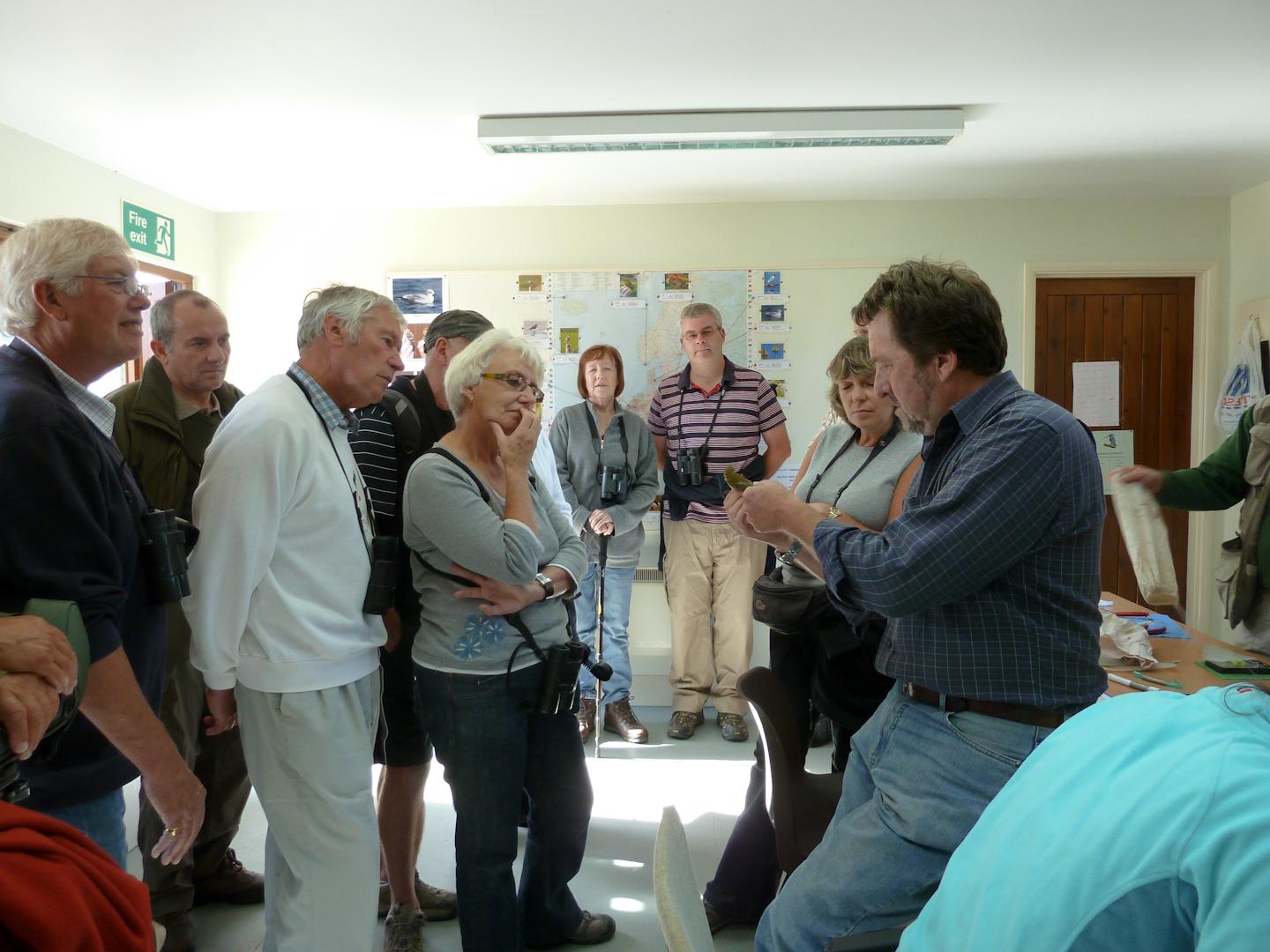
Today I joined friends in my local RSPB Group for a walk at Sandwich Bay - we started at the observatory, where the staff there gave us a great demonstration of bird ringing.   Whilst we waited for the ringers to come back from the nets with the birds we concentrated on the birds we could see from the car park.   The first bird was a sparrowhawk which flew over twice.   House sparrow and chiffchaff seemed to be the most numerous birds, but there was one willow warbler too.

How many people can you get in a hide?
After a while the ringers returned with the birds in fabric bags carried carefully into the ringing hut.    Then four staff started to deal with the birds and their colleague wrote down the measurements and figures.   We watched as chiffchaff, blackcap, garden warbler and great spotted woodpecker (by far the noisiest) were all ringed, weighed, measured, aged and sexed before being released.   Thanks to all the team but especially Keith who took time to show us several birds in the hand, and explained identification points for us.

The scrape
We then moved off towards the scrape further down to road, pausing in the car park to see a mediterranean gull which was called out by one of the other birders present.  

In the fields along the road we spotted crow, jackdaw, magpie, wood pigeon, and starling.   There were also a large number of gulls - mainly black-headed - swooping over the fields but too far away for us to pick out any other potential species.  We all tried to get into the hide, but the reality was that there were far too many of us, so some of us did a bit of field scanning - lots of cows, a few cyclists but very few birds in evidence, just a couple of rather shy linnet seen by two and missed by the rest of us!   When we got into the hide however the scrape held a little egret, green sandpiper, moorhen, ringed plover and several teal.


Speckled Wood
 It was now time to move towards the sea, and we took a footpath through Restharrow Dunes Nature Reserve.   Blackbird, chiffchaff, blackcap and blue tit were using the trees and shrubs and we also saw peacock and speckled wood butterflies.   As we walked on through the woodland we noticed evening primrose and common storkbill. 

After lunch on the beach, where we saw some black-backed gulls, we walked towards the golf course, and followed the footpath along the edge of the course.   Meadow pipit and stonechat were seen, then a possible whinchat seen by two of us, but then not spotted again.   

The rest of the walk back to the observatory was quiet, and we decided to continue on to the river behind the buildings - our reward was a mute swan!

A great venue, and a good walk, but a bit quiet on the bird front.

Friday, 16 September 2011

Nicky's Collared Dove

A friend has a collared dove which has been trying to nest in her palm tree near the house.   All through the summer eggs have been laid which have fallen through the holes in the bottom of the nest, but generally there has been a bird in residence.

Nicky's dove
For the past two weeks one bird appears to have decided not to move at all.   Continual residence without any apparent assistance or food supplies from another bird.

A day at Cliffe Pools

It was Wednesday - so it must be a birdwatching day!

Redshank
This week we decided to try Cliffe Pools, my local RSPB Reserve.   There had recently been reports of large variety of waders so we wanted to test our skills.

Kestrel

 From the car park we saw wood pigeon, magpie, tufted duck, coot (at least 130), black-tailed godwit, redshank, little egret, little grebe and cormorant.   As we scanned through the redshank, Malcolm noticed a spotted redshank amongst them.   A kestrel hovered overhead for a while before moving off to perch in a tree in the distance.   We moved towards the Saxon Shore Way where chaffinch, robin, great tit and blue tit flew across the track ahead of us.   A hobby came towards us and disappeared over towards the village.

Greenshank
Huge numbers of starling were flying around over the fields making their beautiful patterns in the sky.   Pied wagtail were feeding at the waters edge, and a grey heron took to the air.   Along the sheltered track of the footpath peacock, comma, painted lady, small heath, meadow brown and red admiral were seen.   At one stage there appeared to be a new emergence of red admiral feeding around ivy and hawthorn, and a great quote from Sally - "three red admiral in one binocular"!

Back to the birds and our next few birds were more waders, avocet, oystercatcher, ringed plover, little stint, dunlin and a really good view of a greenshank at the base of the bank.

Avocet
We took lunch by the sea wall and then walked back towards the car park along the edge of the river.   At the end of Flamingo pool there were more of the above waders, but added in were several bar-tailed godwit, and behind them some grey plover - two in almost summer plumage, and the rest in the more usual winter colure.   We watched more small birds arrive - a couple of curlew sandpipers, in with some ringed plover.   As we scanned the short grass at the end of the pool we realised there were high numbers of ringed plover sheltering in with equally numerous lapwing.  

On the way back we added more coot, redshank, little grebe, tufted duck and little egret.

Happy Birthday Sally!

Oare
As it was a significant birthday for Sally (but then aren't all birthdays) we decided to treat her to yet another day out birding - so the Wednesday wags convened on a Monday!

The weather was grey, wet and windy, but we didn't let that dampen our spirits.   Our initial venue was to be Conyer Creek, but as the weather was so inclement we decided to change to Oare, always a good option, and with the benefit of hides to give shelter.

Waders Galore
With a rapidly rising tide we did the usual clockwise circuit, and along the shoreline were dunlin, curlew, redshank and black-tailed godwit.  A kestrel hovered overhead, and a cetti's warbler sang in a nearby bush - just audible over the wind!   Great crested grebes were feeding in the river and as we watched a cormorant flying down river Sally spotted a swift flying past in the opposite direction.  

Near the first hide were large numbers of waders, and we added avocet, knot and oystercatcher to our day's tally.   Huge numbers of black-tailed godwit were flying into the reserve as the tide rose, and in one group we noticed birds with no wing bar, so we had definite bar-tailed godwit to look for when we got to the second hide.

Golden Plover
We still had some birds to see and lapwing, herring gull and turnstone were spotted as we started along the creek.   A sandwich tern was spotted flying over towards the scrape, and the distinctive "ping" of a bearded tit led us to several short glimpses of the bird which was struggling to fly in the strong wind.    There were several hundred starling flying around, one a distinctive "blonde" colour which stood out among its more usual coloured flock.  

Sea Aster
The sky started to brighten a tad as we reached the second hide, and we took the opportunity to enjoy the respite offered from the battering gale outside.   Three yellow wagtails, several ringed plover, large number of coot, a few teal, were seen.   The large flocks of waders were scanned with telescopes and binoculars, black- and bar-tailed godwit, redshank, ruff, made up the majority of the raft, and a few grey plover added into the mix.   Malcolm noticed two waders fly in and realised they were golden plover, they landed near to the sandwich tern which had flown in earlier.

Along the Creek
By now we were all hungry, and we made our way to the Shipwrights Arms on the other side of the creek.   After a hearty lunch and a toast to the birthday girl, we decided to take a short walk along the creek from the pub garden.   The sun shone and although it was still windy, at least it wasn't cold, we noticed sea aster sheltered from the wind in the lee of the seawall, and a small bee laden with pollen.

Wheatear
Several yellow wagtails and a wheatear flew along the path ahead of us.   We stopped to watch the wheatear then realised that there were another two birds further away from us.   All three were sitting up in their usual habit, watchful of their surroundings.  

One rather sad note is that there is a proposal to extract 2 million tonnes of ballast from Hollowshore and Ham marshes over the next 15 years as part of the KCC Mineral and Waste Development Plan.   The Shipwrights Arms are collecting signatures to object against this proposal.   If you want to add your name please go to www.kent.gov.uk/mwdf

We did try to see as many species as Sally's years but we were a few short!

Wednesday, 7 September 2011

Bough Beech & Sevenoaks

Still not at full strength, but at least this week there were four of us - Irene having decided to go to South Wales for the week.

Little Egret with green algae
We headed off for Bough Beech Reservoir to see what we could find.  The good news was that the visitor centre is now open on Wednesdays and they make a lovely cup of tea.   We did manage to find several avocet, including one with colour rings, three green sandpipers, five buzzard, kestrel, hobby, and numerous sand martins.   These were supplemented by the usual; grey heron, little egret, cormorant, greylag geese, moorhen, mallard, ruff, mute swan and huge numbers of great-crested grebe.   Whilst Malcolm and I wandered off to the visitor centre, Sally and Paul were getting great views of a kingfisher.

From the picnic table we watched swallow flying in and out of the barn and when we followed there were at least three nests which had been recently used (given the droppings on the floor below), and there were three juveniles perched on a cross beam still being fed.  We watched as they preened and stretched their wings.   One of the youngsters did fly out of the barn, and returned several minutes later, so it won't be long before they are off on their first long journey south.

We then moved off to Sevenoaks Wildlife Reserve run by KWT.   Once again another great supplier of tea (I wouldn't want you to think that we don't take our birding seriously, but as we usually have no facilities and no provisions available, it's great to have a more salubrious outing every now and then).

Spot the humbug!
After we had taken lunch (and more tea!) we set off on the nature trail, near the car park we could hear robin and blackbird, and a blue tit flew across our path.   On the lake we could see cormorant, coot, moorhen, greylag and canada geese, grey heron, lapwing, house and sand martin were feeding over the water, and little grebe were diving. 

Malcolm spotted a great-crested grebe on a nest and we put the telescope up to see if there was evidence of eggs, as I watched, the bird started to preen and as the wing moved I could see a small stripey humbug juvenile sheltering underneath.

There were lots of tufted duck, on the second lake with 83 canada geese, mute swan, pochard, teal, more sand and house martin, cormorant, and mallard.   We watched a fox creeping along the side of the lake - he appeared to be munching on a worm.   Geese, teal and a young moorhen seemed to get dangerously close, but the fox seemed uninterested and lay down on the grass.  

Young Great-crested grebe
As we moved back towards the visitor centre, Sally spotted a kingfisher swoop down from the trees then disappear into the far trees.   We decided to go round the lake to a small hide in case the bird could be spotted from there.   A great decision, as the kingfisher was sitting out on a branch and gave us great views.   As we watched it flew down to grab a fish and then flew first right (and out of view) and then back to the left where it initially sat on a branch and then disappeared into the bushes.

By now it was time for us to take our leave, so a quick look from the hide by the centre where we increased the numbers of ducks already seen, along with some young blue tits on the peanut feeders, then it was off home.