Blog Archive

Thursday, 19 May 2016

Hello Chachuna!

Exciting times as we are to move to the Chachuna area today.

A Laughing Dove called from a telegraph pole outside our hotel - what a great alarm clock.   After a quick breakfast we were on our way.

Leaving Tblisi, we headed east and south, away from the magnificent scenery I had come to love, and to lower Savannah-like habitats with riverine forests.

Turtle Dove
The journey was great, giving us an insight into the driving mentality of the nation and thrills you would pay for at Alton towers, but all safely dealt with by Levan who is obviously well versed in his fellow countrymens' erratic decision making.

To enhance our enjoyment of traditional Georgia, Levan stopped to buy us some Churchkhela - an interesting snack that is sold from small stalls along the road.   It is basically a string of nuts covered in flour, sugar and Badagi (concentrated fresh grape juice).   Very nice, and not as sweet as you would expect, it helped to keep us going until lunch.
Evan negotiating at a roadside Churchkhela stall

We stopped at yet another delightful local restaurant for a lovely meal (which we decided was the best of the trip so far) before leaving the metalled road behind and continuing on dirt tracks.   With farmers moving their sheep and cattle along, dogs and horses in tow, the vast grassy landscape was in sharp contrast with that of the previous few days, but no less stunning.   


There were many stops for birds as we continued along, with Turtle Dove, Common Stonechat, Black-headed Bunting, European Roller and European Bee-eater, there was plenty to keep our interest.   

Close up of Churchkhela
At one stage a Red Fox was spotted running across the field at the side of the road, as Levan hooted the bus horn, it turned giving some the opportunity for a photo.   Little Owl was spotted on a derelict building, well camouflaged initially, but when it moved we all had great views.

We stopped to view a distant Eastern Imperial Eagle nest on an electricity pylon which whetted the appetite for more, and as ordered, Levan knew just where to take us for closer views.   Spanish Sparrows were nesting in the base of the Eagle's nest, such is communal living in the bird world.   When the adult left the nest to take to the skies it was a mesmerising sight, such a huge bird soaring effortlessly in the thermals was one more special Georgian moment.

Spur-thighed Tortoise Testudo graeca
A small lake appeared and I noticed a Crane - Demoiselle - which turned out to be a lifer for three of the group - we would have seen it anyway, but I accepted my initial plaudits!   Ruddy Shelduck, Mallard, Black-necked Grebe and Common Sandpiper were also present - it felt like a re-run of Doñana for a while!

Another stop for Isabelline Wheatear and then Black-eared Wheatear appeared, we got off the bus to get closer views, which were brilliant.

Demoiselle Crane
Our arrival at the accommodation was welcome after such a long day, but as the light held until well after dinner, most of us wandered off to enjoy the call of the birds as they settled for the night.

As I went to sleep Common Nightingale were calling in all directions, a Scops-owl called nearby and Golden Jackals could be heard in the distance.

Wednesday, 18 May 2016

Farewell to the Mountains!

Day four dawned, bright and sunny but chilly as we scanned for Caucasian Snowcock once again.   We met some Swiss birders who were on the same game.   Luckily for us we were led by Nico who found not one, but two calling from a ridge in the mid-distance.   We all had great telescope views and much digi-scoping took place - thanks to our local guide Levan who is a dab hand with almost any telephone!   We, of course, called our Swiss friends over to enjoy the fun.
Farewell to the Mountains
Caucasian Snowcock thanks to Levan!

Lower down the slope and more sightings of Great Rosefinch, Ehrenburg's Redstart and Güldenstädt's Redstart before breakfast.   

Once packed we made for the Jvari Pass on our way to Tblisi for the night.   

One of the roads leading into Russia had been blocked and we passed by a very orderly queue of European Lorries which reminded me of  Operation Stack.   

Snow on the pass prevented our stopping too often, but with lunch on the road in a restaurant that conveniently had Semicollared Flycatcher nesting in the wood behind, and some excellent food, the journey was a pleasure.


Once we had booked in at our hotel, some of us decided to take in the delights of Georgia's capital and go for a wander.
Kartvlis Deda

Tbilisi is overlooked by Kartvlis Deda, a statute of a lady with wine to welcome friends and a sword to welcome enemies - (must get one for the porch) - this 20 metre aluminium statue sits high over the town marking Georgia's 1500th anniversary.

Tblisi is a mix of old and very modern architecture and very interesting to wander around - a return trip is required!

Tuesday, 17 May 2016

One Very Happy Girl!

There had been tremendous thunderstorms overnight, and the heavy rain still fell as we met at 7 am, so we delayed our start until after breakfast then set off for the Russian border.  This was a rather eerie place where two of us got mistaken for Russians and had a very one sided conversation with a  local - at least he tried to converse!
The Gateway to Russia

On our way there were some Common Linnet feeding on a dung heap in the rain - we decided to get back in the van rather than get soaked.

We waited around the border where there are steep sides to a gorge which makes this outpost an ideal defence area - with old fort ruins on the hills, I am sure lives have been lost here.   After a while the rain stopped and blue sky appeared so we moved off to a small track which led to nirvana.   

An area where there was a small lake with reed beds, high in the mountains with high peaks all around us.  A Purple Heron was our first sighting, followed by Rose-coloured Starling, Rock Bunting, Willow Warbler, Caucasian Chiffchaff and finally, the pure gold sighting of a Lammergeier - close, low and absolutely stunning - just magic.   It made the number of Griffon Vultures we had gazed at well worthwhile.   Then two more appeared and eventually we had three individuals circling overhead.     

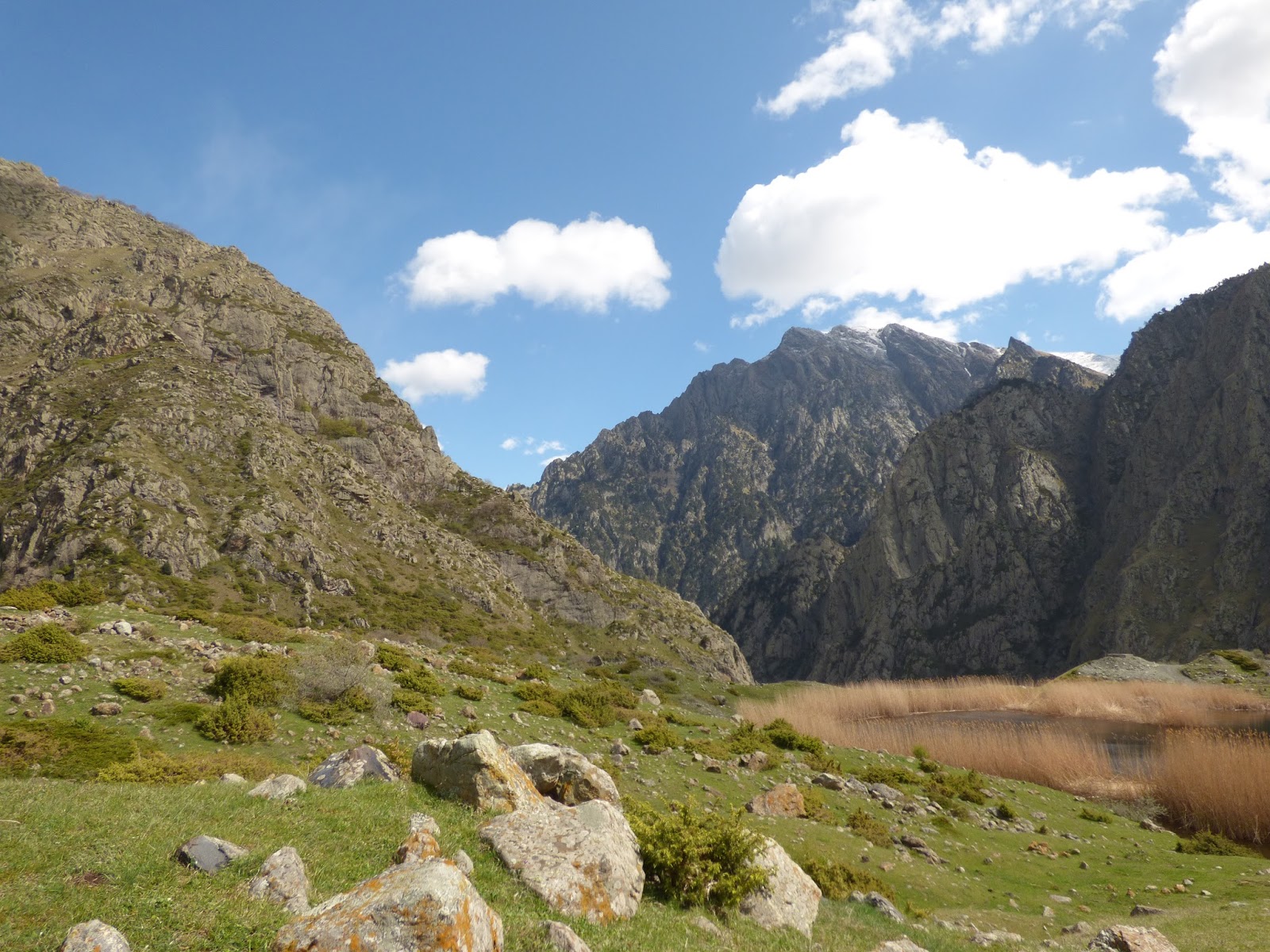
Devdoraki Valley - Lammergeier land
Thanks to Nico for the loan of the bins, which gave me fantastic views of a bird that has eluded me for many trips/years.

As we moved back towards the bus, we enjoyed the scenery and beautiful wild flowers which were blooming in perfusion and found a couple of Caucasian Brown Frogs (Rana macrocnemis), and some tadpoles.

We spent some time here just enjoying the scenery, the grandeur and marvelling at how the views changed as we moved around the valley.

Time to move back towards base and with a second stop just outside town, which proved as rewarding as yesterday, we were soon in a local restaurant enjoying local dumplings, kebabs, wonderful breads and pear and tarragon juices. 

Caucasian Brown Frog
The afternoon was spent revisiting previous sites to try to see Snowcock and other mountain specialities.   We managed to add Güldenstädt's Redstart, Garden Warbler, Eastern Olivaceous Warbler and heard Thrush Nightingale. 

We eventually moved to an area by the river where access was interesting to say the least, but three Corncrake were heard calling.  No sightings, however and as the rain started again, we decided to retreat, but not before we found another Frog and this time some spawn.


Monday, 16 May 2016

Kazbegi

Day two and an early start to get in place for Caucasian Grouse and Caucasian Snowcock.   Both are found on the slopes of the mountains above the village, and although there appeared to be several groups all with the same intention with the open land and no hope of getting physically near the birds we set up our viewing spot and waited.   
Good morning world!

As the sun came up, the snow-topped mountains were beautiful, and we marvelled at how the different facets of the mountains were revealed as the light hit them.   THE best start to a morning's bird watching. 

The Grouse were first to appear, and although the Snowcock called often it was a while before we saw one.   

In the meantime we amused ourselves with the Grouse, the males lekking and showing their long tails off beautifully.  

In front of us a male Northern Wheatear was gathering food for its young family and throwing in some display flights for good measure.    Water Pipits were everywhere and there were some very distant and cryptic Eastern Caucasian Tur, an endemic mountain goat, which perfectly matched the colours of the high rocks - as they moved we found eight individuals.
Gentian, just one of the beautiful flowers we saw

One of the other groups found the Snowcock and word soon got out.   Soon we were all enjoying rather distant but good views with the telescope.  Hopefully there will be better to come.

Ring Ouzel was perched in a tree as we moved off for breakfast.

Breakfast


More local birding found Common Rosefinch, Greater Rosefinch, Mistle Thrush,  Common Kestrel, Raven, both Alpine and Common Swift, Tree Pipit, Willow Warbler, Whinchat, House Sparrow and in one of the larger copses a group of Red Squirrel some still in their winter coats and looking particularly dark.  

At one stage a distant Lammergeier (the species at the top of my list for the trip) flew away from us and gave a rather frustratingly poor view - hope I get another shot at that one!
Wallcreeper heaven

Lunch and then a trip back to the Jvari Pass, via a lovely basalt rock cliff face along the way.   Here we found Black Redstart (with rufous belly), had back-lit views of a sole Red-fronted Serin and fantastic views of Wallcreeper - both male and female were feeding young so their busy life was great to watch as they collected food and flew to and from the small gap in the rock.

Next stop produced a large flock of Twite, then on to the Russian built viewpoint for Rufous-tailed Rock Thrush, Alpine Chough, and Crag Martin.

Highlight of the day - Greater Rosefinch

Sunday, 15 May 2016

Next stop Georgia . . . .

Heathrow-Istanbul-Tbilisi and after an overnight journey we arrived around 4:30 am Georgia time.

Formalities and introductions completed and we were soon on our way to the Caucasus mountain area with birding on the way.   
Excellent Migrant country

Breakfast was Georgia cakes and coffee, and the stops by the roadside gave us a gentle introduction to the birdlife, much of which we recognised from home.   

Nuthatch, Blackbird, Greenfinch, Goldfinch, Great and Blue Tit, and Blackcap, were mixed in with Middle Spotted Woodpecker, European Bee-eater, Armenian gull, Black Kite, Griffon and Black Vulture, Ortolan and Rock Bunting, an eclectic mix to start with.

Common (Steppe) Buzzard and European Honey Buzzard put in an appearance with Eurasian Sparrowhawk shooting through as well.

At the Ananuri Monastery, Nico managed to flush a Common Nightjar which we quickly rebound, but only long enough for a couple of us to get good views.    Barred Warbler, Common Whitethroat and singing Cuckoo managed to create sufficient excitement to keep us all fully alert.
Looking for Semicollared Flycatcher :-(

As an aside: Interestingly at this point my binoculars were in fine fettle - one short mini-bus journey later and the focus was knackered and I spent the rest of the trip with only a small amount of focus adjustment with the right eye only and a foggy out of focus blur with the left!   Still is not what life throws at you that matters its how you deal with it - so I stoically soldiered on with the generous offerings of both guides and fellow travellers at key moments.  Thanks to Nico, Levan, & Jon.

A White-throated Dipper was visible from our lunchtime restaurant, and as we continued our journey both Lesser Grey and Red-backed Shrike were seen.   

As we neared our destination the mountain tops were snow-topped and the scenery magnificent.   So many wonderful sights we ran out of words.
View from my hotel room

Bird of the day for me had to be Güldenstädt's Redstart which showed off from the top of Blackthorn bushes as we had a late afternoon stroll, but after dinner and checklist it was an early night after a long first day (and a half!)


Monday, 9 May 2016

Photographs of Spain

If you want to look at the photographs from this trip check out the link below:

Flickr

Sunday, 8 May 2016

The Uplands

A day away from the coast, and high up into the hills and beautiful countryside for our last day.

Rolling hills with yet more of those delightful flowers that have been thrilling me all week.   A first stop for Little Bustard was totally successful, and we were buoyed up with that as we went for the second hope.  We also spotted an Osprey carrying a fish, and watched as it perched on top of a telegraph pole and proceeded to eat it until another bird mobbed it and it flew away.

Rolling Countryside
We started in an area where our guide's uncle had been the forestry engineer responsible for bringing the land back to its former glory, from being used for agriculture.   Replanting native species and encouraging a wide diversity of wildlife to return to the land.

This is also a protected area for Great Bustard - our hope for this morning.   After scanning from one site, we moved nearer to where the dot of a bird had been seen, and initially spent our time enjoying odonata and butterflies.

However, one of the group soon had a bird in his scope, and although we didn't get another scope view, I was lucky enough to be standing in the right place to see it fly - excellent views of those huge wings and amazing that it just disappeared into the undergrowth not to be seen again.
Bee Swarm
One member of the party found a detached birds head which was identified as Osprey by the beak.   The deduction was that it was either shot or taken by an Eagle Owl, so the relevant details were taken, and will be reported.

We caught up with Spanish Marbled White, Small Copper, Meadow Brown, Wall Brown and Small White butterfly, and Western Clubtail, Black-tailed Skimmer, and another unidentified dragonfly.

We were in Black Vulture country today, and they did not disappoint either, with several flying in formation over and around us as they rose in thermals.

Next stop Coffee and Cake, before we were off again looking for (and finding) Blue Rock Thrush and Rock Bunting to be specific.
Wild Gladioli

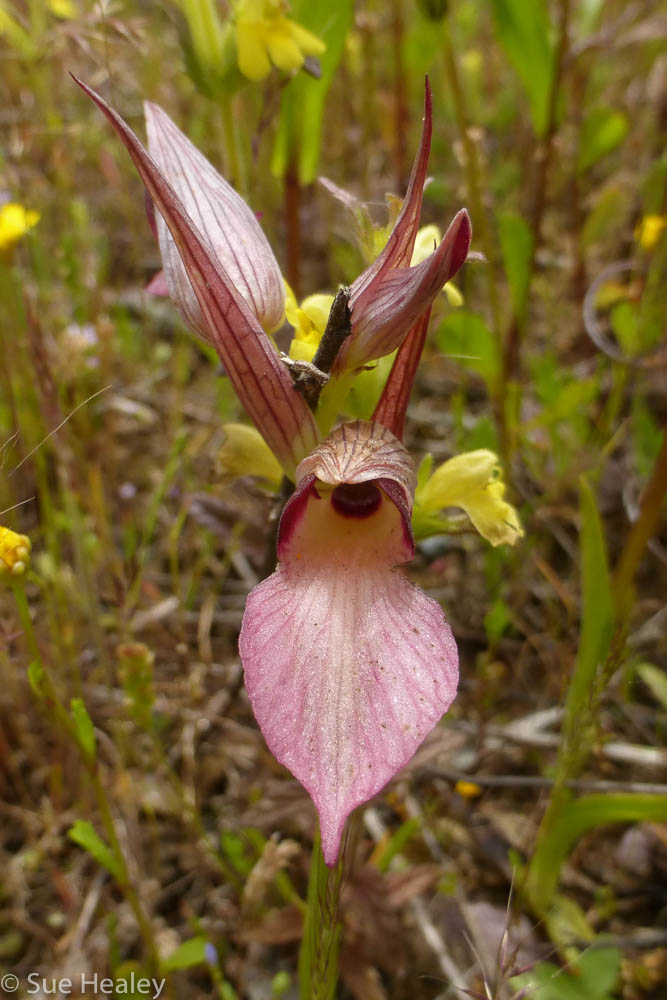
After a picnic lunch we were off again, and after stops for some beautiful Tongue Orchids, and a bee swarm we were checking out an area where Black Stork had previously nested.   As the last couple of years had been dry, the pair had abandoned the nest site, but glory of glories, there was a bird there!   We watched for ages, as it preened and stretched and looked around to see if we could see a second bird.  The nest was empty and in fact has greenery growing on it from lack of use in the previous two seasons, however we did see a pair of Black-eared Wheatears, one with a pale throat and one with a black version.   Next up were Linnet and Wren.  Then a pair of Red-billed Chough flew across the quarry several times giving us some great views of their red bills in the sunlight.

As we were about to leave the area our Black Stork took off, but then as we were all aboard, and ready to drive off, a second bird appeared, and they went from the nest to the perch and back, then finally both took to the air where they road a thermal and we were delighted to see them moving together in the sky.

So, we are all crossing our fingers in hope that this pair will find sufficient food to breed this year.

Tongue Orchid
White Storks are far more successful, with their ability to nest anywhere, eat almost anything, and with no regard for humans and their disturbance, there are currently around 17,000 pairs in Spain.   The Black Stork however is a more shy, secretive bird and is a solitary nester requiring peace and quiet, and relies almost totally on amphibians and therefore needs wet areas to feed and thrive.   They are recovering slowly but still classed as scarce in Spain.

Saturday, 7 May 2016

Night Birding

Just to make myself feel at home on a birding trip, a wander locally for some Red-necked Nightjar was the order of the day.

An interesting piece of scrubland with a power line going through it providing an excellent 'ride' for walking and viewing.   Although one bird was heard, it was dark before a second was heard and then sightings against the sky of three birds flying.  

A great delight, but hearing there had been one sitting on the wire for some time prior to my arrival did not cheer me to the core - the sound, however was evocative in the dark and a thrill in itself.

Friday, 6 May 2016

Just like being at home

The Odiel Marshes are an important wetland area, mainly made up of salt pans which provide a fantastic area for wildlife to feed and roost.

Marshlands
Although we saw old friends such as Flamingo, we did find some thrilling new species for our records, including a pair of delightful Little Bittern.   They flew across the path in front of us, giving great views, then dipped into the reeds.   With patience we managed to see them a further three times, twice as they moved up the reeds (probably to see what all the noise was) and then as they flew back across the path back to their original position.   Marvellous views and a great start.

Waders were the order of the day with my personal favourite, Kentish Plover playing a leading role.   Curlew Sandpiper, Redshank, Whimbrel, Dunlin, Grey Plover, Ringed Plover, Sanderling and Little Stint were all enjoying the food provided by this area.   Seeing the Little Stint running around with Dunlin was an excellent opportunity to compare the size and jizz of the two species.  

Flamingos
Another size comparison opportunity with Sandwich and Little Tern side by side.   Movement along the raised bunds between the salt pans made the Fiddler Crabs scurry to cover - an entertaining sight.

The area has benefitted from some hard working conservation efforts, including the addition of nesting towers for Ospreys - some complete with wooden osprey statues to keep the storks at bay.

Fishing Boats in the Atlantic
As we watched an Osprey on the nest on one side of the road, I could hear a call and turned round to see two displaying Montagu's Harrier on the other side of the road, with a further female following further behind.   A female Marsh Harrier added to the confusion, but they soon sorted themselves out with the Marsh Harrier remaining over the marsh area nearer the river and the Montagu's keeping nearer to the road - lucky us!

After enjoying this area for some time we moved off along a sand spit which sticks out into the Atlantic - Evening Primrose has been introduced from the USA via the ships cargoes landing in port.   Although there have been efforts to remove it, the plant continues to flourish and was providing some source of food and shelter for various insects including Common Swallowtail butterfly.   Sand stock was another delightful find which appears to be native.
Evening Primrose

Purple Heron, Slender-billed Gull and Avocet were also great additions to the day.

Thursday, 5 May 2016

Back to El Rocio

Today we are back at Doñana, but the South this time.

Lots of birds on the water today, and plenty of time to enjoy them with less members of the public for us to annoy!

Common Sandpiper flew past, and one lone Black-tailed Godwit preened on a far island.   Greylag and Egyptian Goose made it feel even more like home.

Lynx Country
At at nearby reserve we found a pair of Spotted Flycatcher feeding in typical style on passing insects.   Short-toed Treecreeper called but remained a mystery.   There were several Nightingale singing - I gave up after eight, but I am sure with due diligence I could have easily been in double figures.   I did manage to spot two of them which was a reward for hours of trying.

Lunch was taken in a shady picnic area in another forested area.   Iberian Chiffchaff called and as Manu, our guide tried to find it, he spotted a Lesser-spotted Woodpecker feeding on a nearby branch, tantalisingly near, but not easy to see.

Egyptian Grasshopper was Manu's next find, as I was in pursuit of butterflies including Speckled Wood and Meadow Brown.

Egyptian Grasshopper

Next stop, and a twitch for Penduline Tit - back to El Rocio and, as appears to be the style here, you get off the vehicle and wander up to your quarry, enjoy it for as long as you want and then leave it in peaceful seclusion - happy days.   The nest looked like a small hanging natural sponge, pale and superb.

Penultimate stop of the day was a private reserve which was set up in mitigation by a petro-chemical company.   After aerial photographs indicated the original size of a wetland area, this was dug out and with some expert advice has been restored to great effect.   We found many species already seen, but added Spiny-footed Red-tailed Spanish Sand Lizard or Racer.   Red-veined Darter, and Waxbill, a widely introduced species.

Long-eared Owl
Finally, the University grounds - and the only thing you are looking for in those circumstances is an owl, and a Long-eared Owl at that!   Brilliant end to the day.

Wednesday, 4 May 2016

A day off and back to Doñana . . . . . of course

Finally saw the yellow legs on a Yellow-legged Gull here, as we were driven to the Government managed area of Doñana which covers some 25,000 hectares.

Starting at El Rocio we boarded expedition-style vehicles which could cope with the deep sand of the area.    Mastic Bushes Pistachio lentiscus were the main new vegetation species I noticed.   

These aromatic bushes provide excellent cover for female lynx when they give birth and protect the young from any wandering male lynx with the natural smell of the bush covering up the scent of the animals.
Lynx Country

The lynx population has been sorely punished with Myxomatosis killing rabbits which are their main prey.   Adding the loss of habitat and incursion of roads into their territory  (two lynx were killed in the last year or so by vehicles) it is hard to see how they will recover their numbers.   However work is going on with a captive breeding programme and individuals from the mountain population north of Malaga are being introduced to strengthen the genetic composition.   In addition artificial 'rabbit houses 'are being constructed to encourage them back to the area.
Rabbit hotel from old Cork trees

Cork palm, mastic bush and rockrose are all part of the 'primary forest' here - the oldest vegetation species listed in the area.   This area has been under threat with no significant rain for the last three years, and El Niño waging its affect worldwide.

Still, along with many other species we had seen before, the best spot of the day was a group of seven Pin-tailed Sandgrouse, firstly on the ground, and then as the vehicle moved, they took to the air giving us great views.   

El Rocio
At El Rocio the crowds were gathering as it is only five weeks to Pentecost and their most important festival of the year.    Long queues of people waited to pay homage to the Virgin Mary in the town Cathedral.   Horses are the main form of transport here, and there were many on horseback and being driven around in horse-drawn carts.   Everyone was dressed in the sunday best - a little at odds with us in our creased practical gear!

Tuesday, 3 May 2016

An afternoon in Doñana

The afternoon could not hold as much excitement surely, but we started well with Griffon Vulture overhead, whilst Wood Sandpiper, Spotted Redshank and Short-toed Lark delighted us on the ground.

Greater Short-toed Lark called and made a quick guest appearance, but was then off and away before we could get really good views.

Glossy Ibis, which is a real success story here, with three individuals found in Doñana in 1990, and over 40,000 now.
Flowers providing food, shelter and boudoir!

There were a few more surprises to be had as we moved along through yet more flower be-decked countryside.   I found the vast areas of wild land the most moving sight, and reminded me of growing up in Derbyshire where many places were just as beautifully painted with wild colours.

So, firstly, and a poignant one was Turtle Dove.   A delight to see but when you realise that the Turtle Dove has no protection in Spain (along with much of the rest of this region) and can be shot for sport or tradition, whilst the ever increasing Collared Dove cannot be shot - this was one very precariously perched individual.   We later saw a second bird, and as we left the area I did say a silent prayer that they remain safe.
Wonderful roadsides

A small bird flew into a nearby tree, called and then flew off - a Garden Warbler.   In the same tree a second bird appeared and on closer inspection after re-finding by Clive, it was not something I recognised immediately which is always a good sign - as it turned out to be a Western Bonelli's Warbler, brilliantly identified by Clive and his first.   Beer on him tonight!

Spanish Sparrow and Bee-eaters were calling all around us, and as they started to go off to some tall Eucalyptus trees nearby it was time for us to leave the area.   Our journey was arrested for a while as we watched a couple of Montagu's Harriers hunting over the fields - what a great end to a day.

Monday, 2 May 2016

Doñana here I come!

Today was the day of the Corn Bunting.   Everywhere we went there were 'jangling keys' ringing in our ears.   Sitting on fence posts, wires, the tops of bushes, every small bird was a Corn Bunting, except for the very occasional Cetti's and Great Reed Warbler.
Corn Bunting

The land we passed through was mainly agricultural with oranges, olives and cotton being the main crops.   The forests in this part of Doñana were mainly Cork and Oak and at one point we passed a very important area of "Dehesa" which is an open forest area.   This type of landscape has evolved over time where poor soils need help to sustain a viable agricultural community in harmony with nature.

Cork Oaks and Holm Oaks make up the shade providers in summer and their acorns provide food for livestock in the winter, whilst their roots help to stabilise the soil.   The livestock that are grazed below improve the fertility of the soil.   These areas become wildflower meadows in spring and they provide food and shelter for many insects and pollinators, which in turn feed birds and other creatures.   It also gives a most wonderful sight to travel through and enjoy.

Further along the road Stone Curlew were settled in a field and were flushed as the vehicle stopped.

Water at last for the Black-necked Grebes
A visitor centre loomed up but before we entered there was the European rarity of Red-knobbed Coot to find.   Our first challenge was met immediately we alighted our vehicle.   Collared Pratincole flew overhead.   Black-necked Grebe were present in good numbers, apparently as the rest of the area dries up with lighter rains over the last three years, these Grebes have concentrated in the largest area of reliable water.
Welcome to Doñana Bird Fair

As we were in the area, a quick visit to the Doñana Bird Fair seemed appropriate.   Coffee and cake were on hand, and the opportunity to find our first Terns - of the Whiskered variety.   Unlike the British Bird Fair we were met by a White Stork on its nest as we drove in.

A great site for wildlife watching with all the facilities you could wish for.   Lots of wild flowers again, providing excellent habitat for many diverse species.

Cattle Egret were walking around on the grassy banks, completely unperturbed by the people wandering around.   Although the Fair did not call in the huge numbers of the British Bird Fair, everyone was really friendly and welcoming and a great atmosphere across the whole site.    Soon it was time to move on again with our first stop to see some Black-headed Weaver who should be in Africa!   The male stood out well against the green of the willows it was building its hanging nest in.   In the same line of willow there were Black-crowned Night-heron.  We could see four but apparently a colony of them roosts regularly, so there would have been more in the background.
Doñana Bird Fair

A Gull-billed Tern flying overhead was the next excitement, closely followed by Isabelle (Western Olivaceous) Warbler.   A few minutes further on a Black-winged (shouldered) Kite was seen perched on a bush some way back from the road and rather a challenge for some to find!

Iberian Yellow Wagtail, Squacco Heron, Marsh Harrier, Lapwing and Avocet were all notable attendees for our mornings list.


Sunday, 1 May 2016

The Spanish Countryside

The first full day in Spain was spent exploring the nearby countryside.

Many great things to enjoy, including a Hoopoe which flew back to the nest hole in a wild olive tree right in front of us.

Glossy Ibis
A lot of time was spent scanning the resting rice fields.   Over 40,000 hectares are given over to rice production in the Huelva province of Spain.   Aloe Vera plantations are also providing a great income for locals too.

With Zitting Cisticola displaying, Bee-eaters showing off as they caught insects, over thirty White Storks flying in formation overhead enjoying the thermals, it was hard to know where to look first.

Star Clover
Short-toed & Booted Eagle, Nightingale, Stonechat, Sardinian Warbler, Great Reed Warbler and Woodchat Shrike were our next sightings.   All this in beautiful surroundings with fields and roadsides literally brimming with wild flowers and insects.

House Martin were gathering nesting material at a muddy pool, whilst overhead Barn Swallow, Common Swift and Pallid Swift swooped and soared.
Montagu's Harrier Country

We moved to a local town for coffee where our cafe was opposite a colony of nesting Lesser Kestrel. Pressure on their population has mainly been due to pesticides and fertilisers on the surrounding farmland but a census two years ago showed there were probably around 35,000 pairs in Spain, so hopefully they are recovering.

The best sighting of the day was on the way back to base when two Montagu's Harrier were spotted flying low over the fields in their distinctive fashion.   Such a thrill to see them, especially when the male turned into the light showing his wonderful plumage.

The most interesting sighting of the day was an oil beetle - as yet unidentified.
Oil Beetle sp.

First Impressions - Punta Umbria

My first wander from the hotel was great - first bird seen being Crested Tit (well after House Sparrow and Spotless Starling!)

There were a pair feeding young and getting quite agitated by the keen bird watchers who found them and then proceeded to watch - totally unaware that they were actually standing right next to the nest site.   Needless to say the other folk wandering by were causing no issue at all.  

I had been told to look out for Dartford Warbler in this area too - and my source was very reliable, for within a few more yards they were heard and although sightings were quick flashes, their presence was thoroughly enjoyed.
Planting to protect the area

The wildflower list started well too with Vipers Bugloss, Wild Rocket, Knapweed, Navelwort, Blue Pimpernel, Rock Rose species, Fennel, Gorse and many, many others that I could not even begin to name.   All this within the Enebrales de Punta Umbria.  This is a protected area behind the beach and mainly comprising sand dunes with Umbrella Pine giving shade and cover for this fragile environment.  

Its great that within an area which is built up with tourist accommodation there is still a protected space for wildlife and nature.

Sunday, 3 April 2016

Beddington

After several years of listening to a certain Mr Alfrey bang on about Beddington Farmlands and the fantastic opportunities on this urban site (and just a little about the threats it faces) it was time to venture into South London.
Chatting with Peter


A great day to do it with migration just starting and a lovely sunny day.

We started at the Bedzed Cafe with tea coffee and pastries, then it was off for the grand tour.
The landfill site

Having been prevented from birding for the last three weeks (being a Virus Diva) it was great to get outdoors and look for any signs of migration.   We did not have to wait long with Chiffchaff singing well right from the start, Blackcap, Willow Warbler, Wheatear and Cetti's Warbler all adding to the spring sounds.   Many Robin and Dunnock were heard throughout our visit and groups of Dunnock were seen on several occasions as they chased around in bramble bushes.   With two Swans settled on nests, and lapwing calling and displaying it really felt like we had turned a seasonal corner.
Native shrub species doing well

The different habitats at Beddington have largely come together by default, with three or more owners any changes are a challenge - this has actually helped to prevent too much change in the past -and let's hope that continues in the future, frustrating as it must be to try to get any cohesive management plan together.
Coltsfoot

One of the most pleasing sights were the large patches of Coltsfoot giving a brilliant splash of bright yellow on this glorious day.

With Small Tortoiseshell and Comma, and Bee-fly to round off our day, it was time to go back to the cafe for a well-earned and very enjoyable lunch.

A heartwarming story of what can be achieved with dedication and determination from local people fighting for their wildlife.

Thanks to Peter for being an Oracle and those at the Cafe for their hospitality.

Read more about Beddington Farmlands  here

(all photos from phone)


Monday, 14 March 2016

Dipping in Devon!

Back from a great weekend at Wildlife Crime Conference in Bristol with Peter then on to Devon to meet up with Chris and Helen for some 'R&R'!
Lunch at the BAWC Conference

An early start on Saturday, but all made worthwhile by a brilliant conference with speakers ranging from forensic scientists to professional bird watchers and - for me the real highlight of the day - the Police.  With Sgt Rob Taylor @NWPRuralCrime, illustrating how much can be done with the right people in place and the will to succeed.

Then it was off to Devon for the 'R&R' bit - great to walk by the sea and enjoy some afternoon sunshine, followed by the apprehension of otters and beavers.   Birds all around settling for the night, at least two Tawny Owl calling and peaceful surroundings, but neither mammal showed.

No option but a very early start on Sunday to try again!   Gripped off by a chap who saw otters twice - we missed them, but there's always next time.

Female Cirl Bunting

Male Cirl Bunting

Breakfast then the 'R&R' continued with some birding, Cirl Bunting, Raven, Red-throated Diver, Peregrine and Skylark singing above us in the lovely spring sunshine.   Heaven.

In true Devon tradition we had a Devon Cream Tea for lunch then it was time to return to the hectic south east.

Thanks to Chris and Helen for their excellent hospitality and to Peter for the entertainment - causing us to miss our M5 exit!   


Obviously it was nothing to do with me.   Lol

Monday, 7 March 2016

A three hour journey

A beautiful sunny journey back from Bristol to Kent.   Seven Buzzard - several of them very low over the M4 - one being mobbed by a rather keen Crow.

Nine brilliant Red Kite, they were further West than I normally see them, more west of Newbury and fewer around the Reading area.

Back to sleet and wind as I neared home, but more Buzzard near Clacket Lane, so that spurred me on.