Blog Archive

Wednesday, 22 February 2012

The Highs and Lows of Birding

Grey Heron
Great "highs" today when my usual Wednesday group (sans Malcolm who has man-flu or plague) decided on Riverside Park at Gillingham.   For once we managed to hit the tide absolutely right with a high tide due around 1.30 pm. 

Salt Marshes
Setting out from the car park we heard chaffinch, blackbird and a skylark.   On the bay to the west of Horrid Hill there was a grey heron perched on an old wreck of a boat.   Lots of teal were feeding on the mud with black-headed gulls.   The occasional redshank strutted about and at least 8 curlew probed for food deep in the mud.

Two pairs of reed bunting flew in, the males just completing their breeding plumage.   As we moved out towards the headland we realised that there were huge numbers of shelduck and dunlin along the shoreline.   Several turnstone were also present.  

Waders feeding at the water's edge
Dunlin?
We watched as the tide came in forcing the birds towards us in what turned out to be a spectacular sight - 1,000's of dunlin, shelduck, avocet, redshank and godwit moved ahead of the tide.   Brent geese moved onto the low-lying islands.   Great-crested grebe and a smaller darker bird dived for food - the second bird remained unidentified, too far out to get any features on it.   We had similar issues with another pair of diver-like birds but as they swam further out into the estuary and the light hit them we could make out the distinctive markings of red-breasted merganser - always a lovely bird to see.   This - in case you are in any doubt - was the "high".

Nearer, three small waders puzzled us - looking different to the other dunlin, we were undecided.   With a white supercilium and long bill we talked ourselves in and out of id, could it be a dunlin or a very early curlew sandpiper?   Who know's - another 2012 query.  

Along the causeway huge flocks of dunlin moved from east to west flying directly over our heads, giving a great natural air show, their plumage catching the light as they banked.

Salt marsh mud
On the way to our picnic lunch we found three long-tailed tits feeding amongst the brambles in the car park, along with several house sparrows.   They appeared to be picking insects off the buds on the plants rather than pecking at the buds themselves.   Great close views of some of our common birds which are often sadly overlooked.

Avocet
We decided to move on to Motney Hill.   We walked onto the shore below the field and here comes the "low".   I caught my foot on a flint sticking out of the chalk and dropped like a stone - you surely could have felt the aftershock for several miles!   Although I gained a couple of bruises, and a slight dent to my pride the real blow was that the telescope was damaged.  Although useable it was not stable on the tripod and will very shortly be winging it's way back to Austria for vital surgery.   Thanks to Sally and Irene for scraping me up off the floor.

Can you spot the Turnstone(s)?
The good news is that although the weather was deteriorating, we were still able to get closer views of the mergansers, several curlew, a large number of shelduck and brent geese.   Rock pipit and turnstone flew ahead of us along the edge of the water.   The unidentified diver was spotted again, but still too far away for idenification.

As the rain started we returned to base and offered some TLC to Malcolm in his hour of need.

Monday, 20 February 2012

Skylark

Heard a skylark above the back garden this afternoon - spring is on its way!

Sunday, 19 February 2012

Bristol

Spent the weekend with friends in Bristol.  On Friday I went to visit family in South Wales, and resisted the temptation to "twitch" the yellowthroat - really NOT my style of bird watching.  

Checking the internet it seemed to be very well organised with detailed instructions on where to park and exactly which branch of which bush the bird could be seen.   By Friday evening the instructions had been amended to include "have patience and do not upset the locals".   Glad to have missed the furore.   One buzzard, seveeral carrion crown and a family of magpie were my welsh list for the day.
Kestrel

Today (Sunday) we took a stroll around part of Chew Valley Lake, the tearoom there is great, and gives good views of the lake.   About a dozen goldeneye were showing off their handsome plumage - the males and females seemed to be paired up which fits in with the Kent birds I saw ten days ago displaying.

We had great views of a kestrel as it sat in the top of a leafless tree with brilliant sunshine showing off its beautiful colours.

Over 60 mute swan, 100+ mallard, teal, pied wagtail, cormorant, great-crested grebe, little grebe, robin, dunnock, blue tit, great tit and long-tailed tit were all present.

Wednesday, 15 February 2012

Crossssssbillssss at Clowesssss Wood!! (with apologies to Malcolm)

We had heard that there was a possibility of crossbill at Clowes Wood near Canterbury, so we decided to give it a try.

A site we hadn't been to before this is yet another part of the Blean area complex and has been managed by the forestry commission and has a network of tracks - not particularly easy to match up to the OS map.   We were delighted to find first a female crossbill (not easy to identify with the light) high in a larch tree, but it was showing that distinctive "bull-headed" profile.   The bird flew off and as we moved in the same direction we found a male showing a brilliant red plumage - text book stuff.  
Spot the blobs! Two very blurry Crossbill

Blue tit, great tit, chaffinch, robin, long-tailed tit, jay and wood pigeon all moved through the trees as we continued on our way.   Goldcrest were busily feeding high in the trees, with one rather obliging individual darting around in brambles and ivy at the base of a nearby tree seemingly unaware of our presence.  The flash of bright yellow on the crest showed better than I have seen in a long time.

As we continued our circuit Irene spotted a woodcock flying away from us, and Malcolm saw another one a little later.   Greenfinches were feeding on some small cones at the top of a tree, but the light was quite poor - just their yellow wing flash showing. 
Clowes Wood

Near the pond we could hear a strange noise and as we slowed down to track it down we soon spotted a pair of crossbills.   The light was against us so we moved around to get behind the tree for hopefully a better view.   We were rewarded with views of a brightly coloured male and three females - I also spotted a second male for a short time.

We returned to the car park, rather hungry but delighted with our mornings walk.

Redshank and Black-headed Gulls at Swalecliffe
The next venue was a trip to the seaside at Swalecliffe.   We had a picnic lunch in a shelter on the clifftop at Tankerton with black-headed gulls watching every move, waiting for Malcolm to throw some bread.   A curlew flew past over the sea, heading for Sheerness.   Soon it was time for us to move off and see if we could find a shorelark.   Needless to say we didn't!

However, we did see turnstone, sanderling, black headed gull, crow, brent geese, and herring gull all on the shingle bar.   We continued along to the bridge and then back tracked on to the spit to get a better view of the area.   More dunlin, sanderling, ringed plover, a grey plover, common gull, starling, oystercatcher and redshank all entertained us.   Irene's sharp eyes spotted a purple sandpiper blending in with the seaweed and rocks.

A pied wagtail strutted alongside the path as we returned to the car.

Sunday, 12 February 2012

Everything in the Garden's rosy . . .

Not my garden, but this morning the following colourful birds were feeding in Phil's garden, as it snowed.

Two jay, two male bullfinch, several females, a robin, several blackbird, great tit and blue tit - who said that british birds aren't colourful!!
Jay
Male Bullfinch

-8.5 and still birding!

Gulls over The Patch
Gulls along the shoreline
I was leading a walk for my local RSPB Group this weekend, but as I left home on Saturday morning for the drive to Dungeness I had to question the sense.   It was -7.5 degrees, and the thought of standing on the shingle ridge scanning the patch for vagrant gulls made me shiver.   However, these things have to be done, and as the sun came out as I joined the M20 I began to feel a little more optimistic about the prospects - even though the temperature had sunk to -8.5!

Along the A259 the trees and bushes were white with hoar frost and the sun shining on them created a magical scene.   Narnia had nothing on this!

At the lighthouse the car park was icy but driveable.    The temperature was -5.5 - positively balmy after the journey down.

The sea was flat-calm and with the sun out, this is probably the only time in 30 years of visiting that there was no wind and it almost felt warm.   Common gull, herring gull, lesser black-backed and great black-backed were packed onto the shoreline looking like a foamy edge.   A huge number of lesser black-backed also floated on the patch - again, a sight I have not seen for years, most of the gulls are usually in the air.   Red-throated divers flew past, about a dozen in all and cormorants were also sighted.   Great-crested grebe were bobbing about on the water.  
Bittern

Some people were starting to feel the cold so we moved on to the moat to see if anything was sheltering in the scrub and as we walked we started to thaw out, the feeling returning to our fingers and toes.   As most of the bird reports were centered around Long Pits and the trapping area we  broke with tradition and strode out for potential firecrest and woodcock.    A nice walk to warm us up, but not a bird in sight.

Mallard, Teal and Water Rail
On the way to the RSPB reserve a few of us stopped to scan the gulls near the fishing boats to try to find the glaucous gull which had taken up residence a couple of years ago - no luck there either.   Moving on to the ARC pits, and just as I was starting to think that the day would be a bit of a damp squid, we found large numbers of wigeon, pochard, gadwall, shelduck and coot.

A quick stop at the reserve entrance and John, Pauline and I easily found tree sparrows, lots of them sitting in bramble showing really well in the sunlight.

Lunch at the reserve centre, with more tree sparrow, reed bunting, great tit and blue tit taking advantage of the feeders.   A moorhen pecked around below.

Pintail
We had arranged to meet up for the afternoon session at 1.45 pm, about 10 minutes before we were told that a male smew was showing well in front of one of the hides, so I suggested we start off there.   Unfortunately a few folk had already gone through the centre, but the rest of us had good, if a little distant, views of the male and a couple of females.   In the nearer pool several female goosanders were seen with one smartly plumaged male.   Long-tailed duck came next and as we finally re-grouped a male sparrowhawk was seen sitting in the sun low in a bramble just feet from the hide.   We also had superb views of bittern which was standing opposite the hide on the edge of the reed - having had rather difficult views of bittern at Sevenoaks, this one stood out so clearly, it is hard to imagine how cryptic they can be.

We continued around the reserve towards Denge Marsh Hide, with two female and a male marsh harriers going overhead,  a bittern flew across the reed bed twice whilst we were in Christmas Dell Hide.   I had a bit of telescope trouble when I tried to twist the telescope around to let a small boy look at the ducks, but I eventually managed to find the birds for him.   His enthusiasm and joy was a real boost to a cold day.   His list had previously held "ducks" and we managed to do mallard, teal, coot and little grebe, his explorers binoculars had obviously let him down on the clarity front previously!

Snow on the pool edge
From Denge marsh there were several swans, all of the mute variety, a large number of pintail were upending as they fed, greylag, bearded tit and more wigeon were also present.

From the viewpoint we scanned the greylags in a distant field, but again only mute swans and one brent goose were present.   A female marsh harrier flew in and perched on the side of a dyke looking impressive against the geese.

Sunset over Denge
We finally returned to the car park, flushing a snipe on the way, then it was home for some and off to Icklesham for me - dinner with friends awaited me.   The sunset along the coast road was superb with a red ball of fire reflecting in the water.

Thursday, 9 February 2012

You don't have to be mad . . . . .

But it certainly does help!
Hence, on a cold wintry day with snow falling I found myself with my usual Wednesday crew walking at Cliffe.   As we donned our layers a group of around 30 chaffinch fed on seeds nearby, as we moved around they flew across the car park to nearby trees then returned as their confidence grew.   Linnet were also seen in the flock.
Snowy Cliffe

We decided a brisk walk would warm us up to start with - so (you can probably second-guess this one) we sauntered along getting colder by the minute.  The two most numerous species during the day were little grebe and coot - at least 50 of the former and over 400 of the latter (I have since seen a blog quoting 450).  Pochard and tufted duck were also amongst the first birds seen from the car park.

As we moved off to try and keep warm blackbird, mistle thrush, robin and wren flew ahead of us.   Blue tit and great tit were feeding in the bushes, making their contact calls as we passed.   In the distance a large bird of prey flew low over the fields and pool.   As we watched the white-rump of a ring-tail appeared, confirming a hen harrier.   The acrobatic flight as it hunted over the reeds was a delight to see.

From the track leading to Cliffe Creek we had more little grebe, tufted duck, pochard and added shoveler.   Moving onwards (by now fingers and toes were aching with the cold) we spotted a male goldeneye, as we scanned a second male and three females were found, the two males displaying.   Stretching their necks out then throwing their heads back almost into the water as they enticed their female companions.   We watched for a while, and I took a rather shakey bit of video through the telescope so . . . with apologies

Male Goldeneye displaying
Further along this track we found a 1st winter male, close into the bank with faded white patch - we tried to turn it into a Barrow's but there are limits to our stringing!

On the far side of the pool a grey heron stood on the edge of the reeds with 5 little egret busily feeding nearby - interesting to watch their different feeding techniques.   Pintail up-ended constantly feeding.   With the telescope I noticed a wader which we decided was a greenshank.   Shelduck and shoveler were also present in large numbers.
Dunlin
Soon after we found another smaller bird hunkered down under the bank.   It looked suspiciously like a common sandpiper.
Most of the waders were found along Cliffe Creek, with redshank, black-tailed godwit, at least one bar-tailed godwit, avocet, and dunlin.

At the head of the flamingo pool we found more dunlin, grey plover and two sanderling - a real surprise for Cliffe.   Curlew gave their eerie call across the marshes as we made our hasty return to the car park.

Looking for woodcock
After a very welcome lunch with Paul, it was back out into the cold, this time at Northward Hill, where a rough-legged buzzard had been seen recently.   Unfortunately we did not catch up with that species, and the view from the Marshland viewpoint was particularly cold and windy.  Rook and jackdaw were most numerous.   A kestrel hovered overhead, as we investigated the badger and fox tracks in the snow.

Snow on the marshes
As we scanned the marshes a bird flew across in front of us and into the scrub below.  We waited for it to reappear but no success.   My thoughts were woodcock, but I did not get a good enough view.  We decided to walk to the other viewpoint, in the hope that the trees and scrub would offer some protection from the northerly wind which was whipping around us.   Malcolm noticed the first woodcock, which Sally and I inadvertently flushed as we walked the track.   We continued through the wood and a second bird was flushed.   As we contined to the viewpoint, yet another woodcock flew away from us, giving reasonable views.   One further bird flew back towards the original site as we continued on our way.  


A sparrowhawk flew across the field in front of us disturbing goldfinch, chaffinch and the rooks were gathering in the late afternoon sunlight prior to roosting in the wood.   One grey heron was seen on the marshes, but hopefully it won't be too long before they are present in numbers prior to their nesting season - oh, for some spring sunshine!
Sunset in Galapagos - just to warm things up a bit

Thursday, 2 February 2012

Rainham Marshes

As I had been with friends in Essex, my Wednesday walking friends kindly suggested that we met at Rainham, thus saving me the early morning Dartford crossing experience!

We met around 10.00 am and once again layers were the order of the day as it was a bitterly cold day.   A pied wagtail met us in the car park.


female Reed Bunting
After we had checked in we moved off to do our usual anti-clockwise circuit, stopped at the feeders where there were 8 collared dove on the ground, numerous chaffinch, greenfinch and house sparrow enjoying the peanuts and seeds.

Bearded-tit country
Pintail and cormorant flew from the river onto the scrape to join teal and wigeon.  A stock dove sat hunched against the wind on a nearby muddy island.   Reed bunting and more chaffinch fed along the side of the boardwalk.   From the hide coot, moorhen, lapwing, pochard, tufted duck, gadwall and starling were joined by herring gull, black-headed gull, common gull and greater black-backed gull.   Greylag and canada geese were at the far side of the pool and two grey heron stood completely motionless in the reeds - just their heads showing.   A snipe was pointed out to us by another birdwatcher, hard to see and deep in the bank - a good spot by the gentleman.

As it was nearly lunch time we decided to return to the visitor centre, have some lunch, warm up and then to the second half of the reserve.

The southern path took us past an area where bearded tit had been showing well over the last few days - until we got there of course!  

We walked briskly to warm up and get us to the far hide as quickly as possible.   An Iceland gull had been reported.   When we arrived, the gull was pointed out to us - thankfully, as it was almost impossible to see.   As I watched with the telescope I saw the all-white gull, with no black on the wing tips.   It moved to a slightly worse position, but as it did so the whole bird was visible for just a few seconds.   Another gull moved in front of it and our chance was gone.   Only the head was visible - it could have been almost anything.

Mute swan and little egret were seen from here along with a huge number of gulls, some were slipping and sliding on the frozen pool, their legs reflecting in the sunshine.  

We returned via the 'bearded tit' area and although we saw a beautiful stonechat there was nothing else braving the icy wind.

Rock Pipit
Along the seawall, we found a rock pipit picking about in the rocks in typical style.   More shelduck were on the nearby bay, with black-tailed godwit, dunlin and redshank feeding on the receding tide.

A juvenile gannet had been reported, along with a little gull but both eluded us on this occasion.

Wicken Fen

Another of my forays into deepest Essex with Ken actually ended up taking us into Cambridgeshire at Wicken Fen.  As we drove up the M11 it started to snow and we did contemplate retreating to a local cafe, but as we moved north the snow stopped and we were left with a cold grey day.   Quite a difference to my last trip when we were birding in shorts and T-shirts, watching squacco heron!

On arrival, we donned our layers and went off in search of some birdlife.   The lady in the visitor centre was most helpful and pointed out the areas where marsh harriers, hen harriers and short-eared owls had recently been seen.
Sedge Fen
We started off on the boardwalk from the visitor centre and made for the first hide.  From this we watched chaffinch, blue tit, great tit, robin and great-spotted woodpecker - all taking full advantage of the feeders present.   A moorhen flew up onto one of the feeding troughs and pecked at the peanut feeder above.

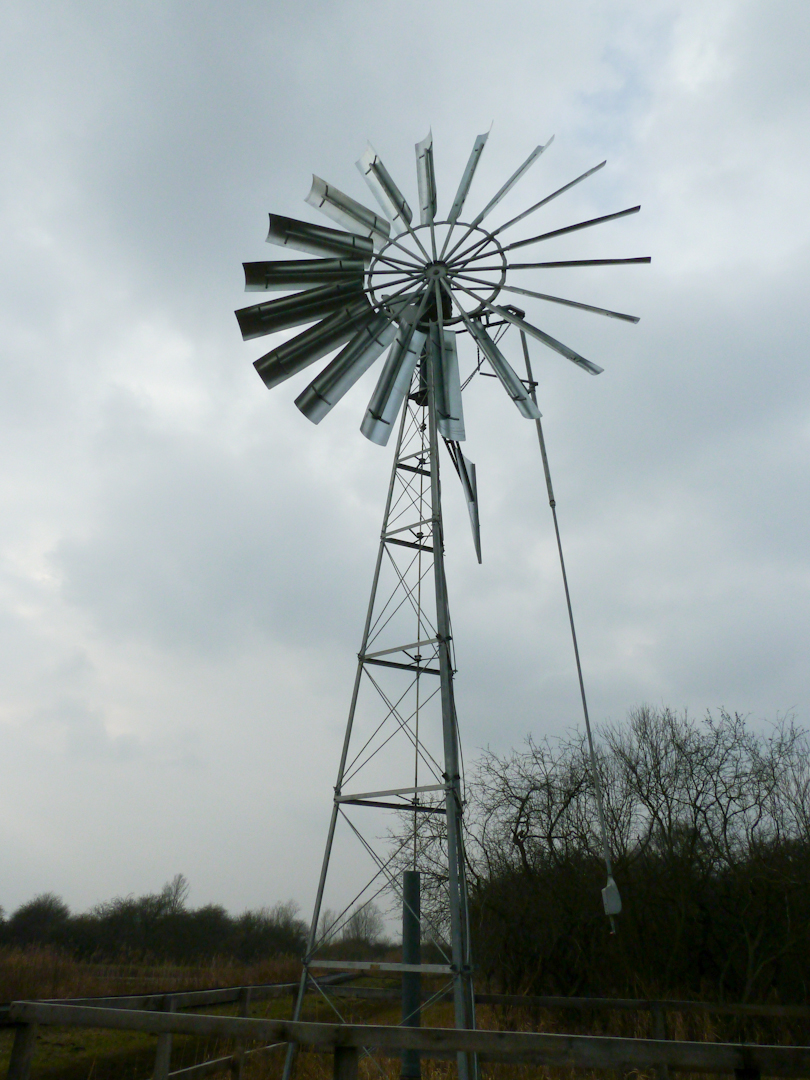
The wind water pump
After a while we moved off around Sedge Fen following the edge of the drainage ditches.   At the first tower hide overlooking Verrall's Fen we had distant views of marsh harrier, kestrel and a female bullfinch.   Cormorants, teal and greylag flew towards a nearby scrape.   At the second tower hide (which overlooked the aforesaid scrape) there were several barn owl pellets and a sign apologising for the mess.  A local owl has decided to take refuge in the hide and had certainly made its presence felt!
There were greylag on the water with a snow goose (it has been listed on and off at the site since October last year by the local ringing group).   Cormorants were loafing in a nearby tree, and mallard and wigeon dabbled in the water.  A short-eared owl made a fleeting visit, just long enough for me to spot it, but sadly Ken was not so lucky.   Konik ponies were keeping the fen in good order with their grazing.


Fieldfare
As we scanned the fens around us for any birds of prey Ken noticed a couple of bullfinches close by, as we watched two males and at least three females fed on nearby berries, giving their contact calls as they went.   As we walked from the hide they flew across to the other side of the dyke, still calling.

At the wind pump we caught up with more chaffinch, and blue tits.   Another harrier - this time a ring-tail appeared in the middle distance we watched as it dipped below the dyke at the far edge of the field hoping that it would reappear further along, but sadly this was not to be.   As we neared the visitor centre we watched blue tits, great tits, dunnock, chaffinch and robin on the feeders with pheasant, moorhen and wood pigeons below.

Afternoon sun on the fenland scrape
After a warming cup of tea and our lunch we were off again, this time to the other side of the reserve, an area where we were more hopeful of short-eared owls as they had been recently seen in good numbers feeding over Burwell Fen.   The sun came out and cleared the clouds away and although it was by no means warm, at least the cold edge was taken off the day for a short while.   Fieldfares were heard "chucking" away to each other and Ken got some good shots in the afternoon sunshine.   The highland cattle were being used in this area to keep the vegetation under control.  They looked superb in their thick winter shaggy coats.  

We continued across the fens towards Priory Farm with agricultural land on our left and the cattle on our right.   Half way across this area the farm gates were open to allow the cattle across and one inquisitive beast decided to stand in our way.  After a quiet conversation (between myself and the cow) we decided to proceed and the docile animal watched with interest, after a quick sniff of the tripod!  
Ken at the bridge sign

After a quick view over the fields at the delightfully named "Cockup Bridge" it was time to move on to the end of our walk as the sun began to set.   A further view of the scrape enabled up to catch up with wigeon and teal.

Another great visit, can't wait for the local RSPB group visit in May now.

Monday, 30 January 2012

East Sussex rapid birding!

I had kindly been invited to meet up with some Brazilian friends for Sunday lunch in Sussex.

As Phil and I discussed my year's list, with white-fronted and pink-footed geese missing we realised we just had time to pop to the Pett Levels. A quick trip through the lanes and we were there, two local birders were on the sea wall and pointed the geese out to us straight away. Freezing cold and with 15 minutes to spare we dashed back, changed and were on our way to a lovely lunch.

An unexpected and rather hasty sighting, but good nevertheless.

Tawny owl called as I left.

Saturday, 28 January 2012

Big Garden Birdwatch

Spent the day at the local garden centre, inviting members of the public to watch birds, complete the Big Garden Birdwatch, and generally enjoy wildlife encounters.   Lots of birds including greenfinch, chaffinch, house sparrow, dunnock, collared dove, wood pigeon, long-tailed tit, robin, great spotted woodpecker, great tit and blue tit.

Nice surprises were a chiffchaff and a couple of kestrels circling overhead and then completing a courtship dive.  

Not all feathers either - squirrel and foxes visited the site.

Lots of great people, keen to share their wildlife stories.    I ended up tired and freezing cold, but feeling like a day well spent.

Friday, 27 January 2012

Oare - an old favourite

After the rain of the previous day, we decided to try Oare where there are some hides if we needed cover.   As it turned out the weather gradually improved and we had a great time.

West Flood
At the jetty area we stopped to enjoy redshank, black-tailed godwit, dunlin, grey plover and common gull - the latter enjoying a view from the top of the poles lining the jetty.

We decided to walk west along the seawall, there were teal, mallard and coot in the pools and greylag on the fields grazing alongside Konik ponies.   On one of the old defence buildings stock doves perched and a rather confused green woodpecker attached itself to the corner of the bulding - I'm sure the brickwork would prove a little hard on the bill - presumably checking for food in the crevices in the mortar.

A female marsh harrier was spotted over Harty and as we scanned for a reported rough-legged buzzard two large white birds landed in a field on the far side of the river.   Under Malcolm's instruction we checked they were not mute swan - he was right, they were spoonbill!  

Avocets, Lapwings and Golden Plover
On the return to the car park we added cormorant, wood pigeon, tufted duck and wigeon.   A flock of greenfinch landed in a bramble bush and as we counted them found a stonechat had joined them.   Skylark, meadow pipit and kestrel added into the mix.  

We returned to the car park to collect lunch which we wanted to have in the hide at the mouth of the creek.   As we walked along the eastern sea wall we heard at least two, possibly three, cetti's warblers.   Over the Isle of Sheppey huge flocks of brent and greylag geese were flying in long skeins as their feeding grounds were covered by the incoming tide.   It continued to push dunlin and black-tailed godwit onto the East Flood.  A turnstone was picking over the seaweed at the high tide line.

West Flood
Bobbing about on the high tide were at least a dozen great-crested grebe, shelduck, and a common seal.   On the East Flood we watched large numbers of godwit and dunlin, lapwing, starling, shoveler, a ruff, a snipe, little grebe and about a dozen pintail.   From the hide by the flood we scoured the scrape for some new species and after careful scrutiny I decided I may have found a little stint - bowing to superior knowledge I waited with baited breath whilst Mr Jennings delivered his verdict!   Success at last, perhaps I am finally learning something about waders.   Or was it just a lucky guess (I leave it to you dear reader to decide - but those who know me will applaud my luck!).

More pintail were found, at least 25 in all, golden plover shared one of the islands with a few grey plover, 57 avocet and some lapwing.   The godwit and dunlin were huddled closely on another island.   As large numbers of waders flew up we saw a peregrine hurtling towards us.  

Shoveler
We had continued to scan Harty and the Isle of Sheppey all day, and our patience was finally rewarded, a couple of female marsh harriers, kestrels, pheasants, and finally a large bird with white on the rump.   With the distance and the grey hazy light, even with the telescope it was hard to tell whether it was a ring-tail or a rough-legged buzzard.   We could have talked ourselves into either.   In any event we enjoyed the sighting, and our knowledge of these two species is increased every time we get the field guide out and debate the issue.

We moved off to the hide behind the West Flood in the hope of better views, but it was not to be.   The greenfinch flock gave us another great viewing, but by now the light was fading and it was time to go home.
Here's to the next time.

Wednesday, 25 January 2012

Weekend Away

I spent the weekend with friends near Hungerford and although the hotel left a lot to be desired, we had red kite from the bedroom window - great to see them hanging in the breeze from your bed.

The river in Marlborough had mallard, little grebe and a surprisingly high number of moorhen - at least 35 were present.

Heard a tawny owl near Chislehurst on Monday evening too.   Lovely sound.

Wednesday, 18 January 2012

A grey murky day . . . .

As it was a grey, overcast and rather damp morning we decided that some cover may be required.   Our Wednewsday walk therefore took us to Bough Beech Reservoir and Sevenoaks KWT today.

From the causeway at Bough Beech we were surprised to see far more water than on our last visit, and a large number of birds were taking refuge here.   A mixed flock of black-headed, common and herring gull gathered on the left hand side, whilst cormorants, great crested grebes, tufted duck, pochard and wigeon swam around.  

Cryptic Snipe
Large numbers of teal preened in groups alone the shoreline.   The greatest surprise was a group of male and female mandarin duck just visible through the murk - at least 48 were counted, but there could have been more females .   I checked on their background, a rather handsome introduction from China where they are not eaten by humans (contrary to popular belief - apparently their meat tastes awful), but they have suffered habitat destruction in their original land and there are now probably more individuals in feral populations around the world than there are in China.

They are known to court in the autumn and then stay in their pairs throughout the winter, often gathering in large groups - hence our large number today.   If the same partners are still alive through two breeding seasons, they typically re-form old bonds rather than establish new ones. Because of their devotion to one another, they are regarded in China and Japan as a symbol of love, happiness and marital fidelity.  Aaah, sweet

Back to the walk.  We moved off towards the visitor centre (currently only open on Sundays).   Along the road a large group of fieldfares flew over and were seen again later as they fed in an orchard.   Robin and greenfinch were seen by Sally and Irene along one of the garden paths whilst Malcolm and I were watching a song thrush.

Beautiful Reflections
The feeders were positively humming with birds; blue tits and great tits were in far to high numbers to count, constantly flitting from feeder to tree and back again.   A female great-spotted woodpecker clung onto a feeder taking full advantage of her size and ability to remove peanuts.   Nutchatch, marsh tit, chaffinch, goldfinch and starlings were using the seed feeders, with half a dozen female pheasants picking up the bits that fell.

Construction work is being done near the visitor centre with a new ramp to the viewing area and what appears to be a hide overlooking the pond.    I look forward to seeing it when it's open later in the year.

On to Sevenoaks, and time for lunch when we arrived.   As we started our afternoon wander, we bumped into Peter and David, and caught up on recent news.   We decided to go off in search of goosander and bittern.   In opposite directions the goosander won initially, where we also saw several snipe, moorhen, coot, lapwing, gadwall and canada geese.  

At the far end of the reserve we found a robin feeding on crumbs left inside the hide (the flap had been left open to enable access) a fieldfare sat at the top of a tree and a chiffchaff fed on lichen.   As we watched, Irene noticed a water rail running across a gap in the reeds.

From the Willow Hide we had rather scanty views of bittern and kingfisher, but much to Malcolm's delight we caught up with egyptian geese!   This prompted a conversation about the number of species we had seen today which had been introduced or were non-native: surprisngly long when you consider the above.

Saturday, 14 January 2012

Shellness and Capel Fleet

The second walk of the year for my local RSPB group was met with an excellent morning of harsh frost coupled with bright sunshine and clear skies.    With a temperature of -0.5 degrees a certain amount of layering was required to ensure we kept warm.

Fields at Shellness
20 of us joined the walk but with a bit of a twist from our usual itinerary.   Earlier in the month Malcolm, Sally, Irene and I had tried a new walk towards fields which the RSPB now own, and where lapland buntings had been reported.   We therefore decided to try this walk - bearing in mind the tide was as far out as it was possible to be, this seemed a good option, and it proved well worthwhile.    The usual wood pigeons sat in the trees with the sun on them bringing out different colours in their plumage and also distorting their size.    A pair of pied wagtail fed along the sea wall.

As we approached the farm track a female marsh harrier appeared in the distance, hunting over the ditch at the far side of the field in front of us.

Reed buntings gave short contact "cheeps" in a nearby bush and house sparrows flitted ahead of us.    Mike spotted a little egret flying away from us across the field, several curlew and herring gull were also joined by lapwings feeding in the field.
A large flock of brent geese were in the same field as our last visit and we checked them for the pale-bellied which I quickly found, as we now know what we are looking for!    Everyone managed good views in the end with a large array of telescopes available.

Further along a large mixed group of starling, golden plover and lapwing flew up in great excitement as first we disturbed them, then a kestrel and a further marsh harrier.   I spotted another harrier had a white patch on the upper tail - a ring-tail hen harrier.

Common Gull
When we had finally arrived in the right area for the lapland buntings it was easy to see lots of birds on the ground feeding but not quite so easy to identify the buntings in with linnet and meadow pipit. A couple of males were found in the group with the beginnings of their black face markings and chestnut nape, and as we watched the group we realised that more of them were buntings than originally thought. The majority being females with the distintive face patterns but little else to aid identification. At least 50 were found in the end.

We retraced our steps as lunch was starting to call us as the main group moved on four of us lagged behind, watching a kestrel on a nearby gate (and in my case taking rather bad photographs of the same). As we stood a water rail walked out from one of the ditches, across the entrance to the field and into a second ditch - a quick but delightful sight.

Back at the sea wall, the tide had come in some way and there were oystercatcher, more curlew, a huge flock of brent geese (who eventually joined those in the field as the tide rose), a couple of sanderling, turnstone, black-headed gull and herring gull. Someone spotted a red-throated diver far out to sea, and as we all tried to get onto it with telescopes, a second was found. A dozen great-crested grebe were swimming along in front of the wind turbines, barely visible as they bobbed with the swell of the tide.

A picnic lunch by the seawall for some and the call of cafes and toilets for others - we were to meet at Capel Fleet Raptor Viewpoint at 2.00 pm:
T697 with friends
For those by the sea, great views of the gulls close up, including an old friend of ours T697 a polish black-headed gull which we first saw as a first winter bird in January 2009. The project team had recently asked if we had any photographs of the bird so it was good to see it and get some reasonable shots for them. Alan spotted a common gull perched on a nearby groyne.


This movie was shot through the scope of a female marsh harrier feeding.   (apologies for the quality)

All too soon it was time to tear ourselves away and move on to Capel Fleet. The viewpoint was busy with not only our group but one from Hertfordshire, and local birders who were probably a bit put out that we were taking over. However we all found a spot to watch and the excitement began immediately with one, two then three short-eared owls hunting over the long grass in the fields, another ring-tail, at least three marsh harriers, kestrel, merlin, peregrine and a barn owl in a nest box completed our raptor list. A great white egret flew in, a pair of green sandpipers moved from ditch to ditch with their call giving them away. Pheasants, red-legged partridge, chaffinch and lesser black-backed gull completed our day's list.

Friday, 13 January 2012

A Quick Twitch

I had heard through the grapevine of a long-tailed duck and shag at Chatham dockyard, so it seemed a bit churlish not to go and try to see them.
Long-tailed Duck

Great views of the duck, the shag proved a little more trying.   Diving constantly to prevent any decent 'scope views, but you can't have everything in life.

Thursday, 12 January 2012

Bossenden Wood

A new venue for me, a part of the Blean Wood complex near Canterbury, and in winter an excellent opportunity for some woodland birds.
One of the Rides at Bossenden

A beautiful day with clear blue skies, bright sunshine and no wind - how lucky could we be!

Although a small area we managed to make a day of it, examining fresh primose leaves emerging, buds on the trees giving them a red aura, and giving us some excellent "firsts" for 2012.

Trees starting to bud
Highlights were many, including a treecreeper which fed in the angle of a branch, a nuthatch, marsh tit, several coal tit, goldcrests feeding in a holly bush, lesser redpoll surprisingly only a single bird.   A sparrowhawk circled over the wood disturbing large flocks of wood pigeons throughout the day.   Blue and great tit were heard almost constantly with their busy contact calls ringing out as they fed in large flocks.   A flock of at least 12 fieldfare flew overhead, and we had great views of  bullfinch with at least three males showing well, their bright colours enhanced by the sunlight. A family of long-tailed tit joined in.   Several male blackbirds were squabbling, jays scolded and we saw and heard at least three song thrush during the day - a species we saw far less of last year compared to previous years.   

An area of scrub recently cleared
Non-avian species also surprised us with three red admiral butterflies taking advantage of the warm sunshine, and also several hover flies seen.

On the way back to the car a flock of around 30 meadow pipits were feeding in the long grass of the fields.

But the star of the day was seeing a lesser spotted woodpecker,  my first for the UK, and a great delight.   Malcolm saw it first, but it then eluded us for some time until a light tapping noise was heard in the distance.   As I moved towards the direction of the sound, the bird flew directly towards me and landed on a branch just ahead, good (if a little quick) views were had by all before it flew off.
The fields leading to Bossenden Wood

What a brilliant end to a great day.  A beautiful part of Kent and well worth a visit.

Tuesday, 10 January 2012

First Resolution Broken!

So four days in and I haven't kept to my wish - to write up these blogs straight away, whilst you remember all those little details - here were are a week later and I can barely remember where I went let alone what I saw - anyway, here goes:
Where did I go for my first Wednesday outing of 2012?   . . . . . . . . . . . . . . . . . . . . . . . .  The delights of Leysdown, Harty and Capel Fleet on the Isle of Sheppey, of course!

We began at the seawall east of Leysdown where the tide was in but receding.   Although it was windy we decide that sitting in the car was the wimps way.   So we watched from inside for a while!

Spot the pale-bellied Brent
Oystercatchers, turnstone, herring gull, and curlew were seen on the beach and sea.   Behind us on the playing field was a large flock of black-headed and common gull stoically facing into the wind.   Magpies were strutting about.   A kestrel was spotted by Sally on a distant telegraph pole.

We walked along the seawall towards Shellness, cormorants were flying past.   A large number of brent geese were in a nearby field.   My comment of "there must be a pale-bellied in that lot" was met with determination by Malcolm to find one.   Within minutes he had.   A handsome beast, with white side and front which once located, seemed far too easy to identify.   We still managed to lose it a couple of times as we set up the telescope though!   Nearby a reed bunting sang before moving off ahead of us.

Turnstone
Curlew, dunlin, golded plover and grey plover fed along the waterline.   Malcolm was convinced there should be sanderling - happy to repay the debt of the pale-bellied, I spotted one on the beach and we all had great views before a dog walker disturbed it.   A couple of godwits tested our newly acquired identification skills of this species (regularly honed but found wanting I might add).   We discussed and debated, referred to the field guide and decided on a bar-tailed.   The bird flew - proof indeed that we were right - no wing-bar!

We decided to wander along a footpath leading to some fields where there may be lapland bunting.   We found a plaque to the first powered flight made by a briton, several barn owl pellets which Malcolm pulled apart, revealing vole skulls, at least 20 more curlew in the fields and lapwings galore, but no lapland buntings.   A flock of at least 15 chaffinch flew into a tree and gave great views.

As we ate lunch in the car pied wagtails ran around on the sea wall, black-headed gulls came begging for food.

Skulls from Barn Owl Pellet
On the way to Harty we stopped to see red-legged partridge, at Capel fleet there were at least 80 mallard, shelduck and a few teal and on the wires overhead a few corn bunting.   As we watched they flew off to join a large flock which had been perched on a nearby bush.   We watched for a while as the group gathered and then small numbers split off as they chose nearby perches. 

At Harty things were quiet with a lone shelduck, grey heron, a few curlew and redshanks on the mud by the river, a distant marsh harrier flew.   On the way back we spotted a (ring-tail) hen harrier which we watched from the car as it flew low over the field.  

A great end to our first trip of 2012

Sunday, 1 January 2012

2012 Begins today!

My first outing of the year to start off my 2012 bird list.   A promising start developed into a very wet grey day, but we were out enjoying the day so nothing lost.

On the beach
We began at Foreness Point near Margate, where our main hope was for purple sandpiper, but first we had the task of finding a mediterranean gull within a mixed gull flock on the beach.   After several attempts and a few false starts we finally tracked the individual down..   Fulmar and gannet were spotted far out to sea, cormorants, and kittiwakes were also seen flying past.   At one stage four divers crossed in front of the distant wind farm, and although probably red-throated, we didn't get a good enough view for definite id.

Purple Sandpiper Habitat (there is one in there)
We walked along the sea-front, scanning the seaweed covered rocks for the purple sandpipers.   We found several curlew, oystercatcher, turnstone and eventually one of our party spotted a small wader along the shoreline, and after further investigation identified it as the bird we were looking for.   Although very active, and hard to see with the plumage blending in so well with the dark weed everyone got good views.   We continued along the beach, with feral pigeons, ring-necked parakeet and pied wagtail seen and/or heard by most folk.

Scanning the sea
On the top of the cliffs we scanned the further beach, but could see nothing new, so returned to our cars and made the short drive to Grove Ferry, where we planned to have lunch.   As we drove it started to rain and by the time we arrived, it was impossible to picnic outside.   After lunch in our respective cars we tried a walk in this part of the Stodmarsh reserve, from the mound we saw a large number of teal, a few wigeon, greylag geese and at least 100 lapwing.   A ruff was mingling in with the geese, but as we tried to get the rest of the group on to it the whole flock took off.

We scoured the sky for the raptor that had put up the birds and a merlin appeared.   It passed over and was seen for a while before flying away into the grey mist.   At this stage we decided to call it a day and made our rather soggy way home.